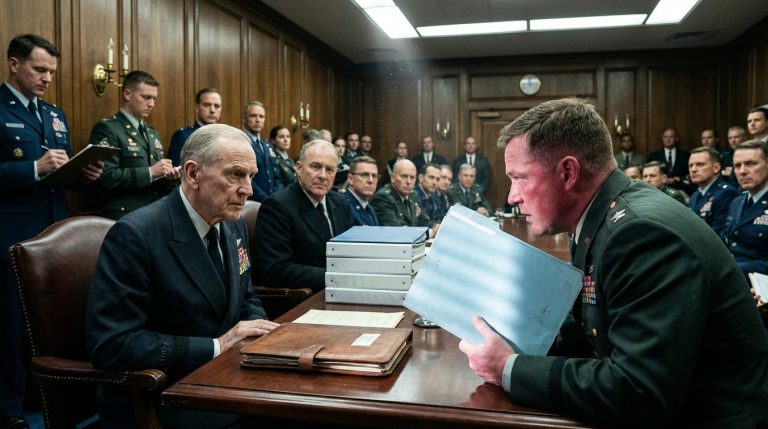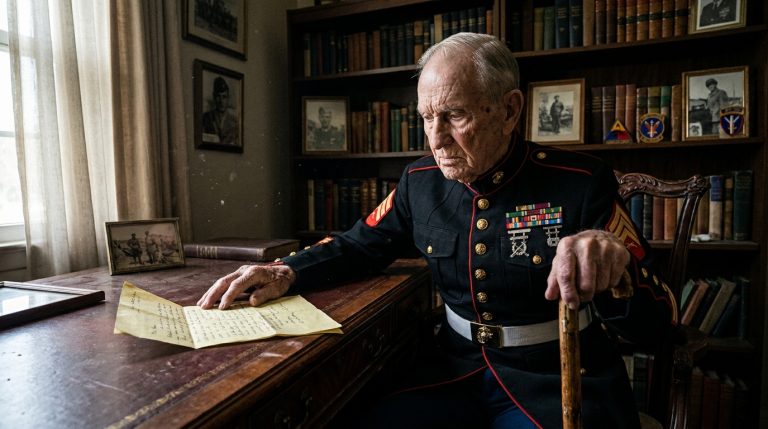
The Hardware Clerk’s Silence: How an Overlooked Veteran Fixed a Broken Range and Broke a Captain’s Pride
CHAPTER 1: THE COLD COUNTER
The wind came off the flats in dry, dusty gasps, rattling the corrugated tin roof of the concession tent. Sweat pooled under the headband of my faded Sierra Vista Hardware cap, but I didn’t reach up to adjust it. I kept my hands flat on the wooden folding table, right beside a tray of lukewarm paper water cups.
Down on the firing line, another shot cracked. The steel plate three hundred yards out stayed completely still.
“Off steel, low right,” the spotter called through his headset. His voice sounded flat, drained by two hours of watching good marksmen miss easy targets.
Captain Vance didn’t lower his binoculars. His uniform was starched so stiff the shoulders didn’t even move when he exhaled. “Adjust two clicks left,” Vance barked to the corporal lying in the dirt. “It’s the desert crosswind. Drive through it.”
I rolled the brass thread pitch gauge between my thumb and index finger. The cold, notched metal clicked against my thumbnail—a steady, quiet rhythm against the range noise. The corporal dialed his scope, checked his cheek weld, and squeezed.
Nothing. Not even a puff of dirt near the target base.
“That’s not wind,” I said. My voice wasn’t loud, but in the lull between rifle reports, it carried straight to the back of Vance’s neck.
Vance turned slowly. His sunglasses were pinned to the top of his head, eyes squinting against the white glare of the noon sun. He looked at my faded navy work shirt, the grease stain on my left sleeve, and the hardware logo stitched over my pocket.
“Excuse me?” Vance said. His mouth twitched into a thin, practiced line.
“Your rail mounts are over-torqued,” I said, holding the thread gauge still in my palm. “The steel receiver is expanding under the sun, but those cheap aluminum rings aren’t flexing with it. Every time that barrel heats up, your optic shifts three thousandths to the right.”
A couple of local farmers leaning against the bleacher rail turned their heads. A kid holding a paper flag stopped chewing his ice.
Vance let out a single, dry bark of a laugh. “Ma’am, this is an official Marine Corps marksmanship demonstration, not a lawnmower repair shop. We calibrate our systems to military specification.”
“Then your specifications were written by somebody who never stood in Arizona heat,” I said.
Vance took a step toward the tent, squaring his chest. The crowd closed in a few inches, camera phones rising like a row of small glass mirrors in the sun. “I suggest you stick to selling nails, miss. My men know how to handle their weapons.”
He turned his back on me, signaling the next shooter to step up to the bench. I didn’t argue. I just sat the brass gauge down on the edge of the wood, the metal burning cold against my skin.
CHAPTER 2: THE MECHANICAL DISSECTION
“Step off the bench, Corporal,” Vance commanded, his voice carrying over the idle chatter of the crowd. “Let’s show our civilian friends how a trained Marine compensates for desert conditions.”
The young corporal scrambled backward, his face flushed red under the desert sun. Vance didn’t take the rifle. He gestured for his spotter to take the shooter’s position, eager to put on a show of effortless authority for the spectators craning their necks behind the yellow caution tape.
I didn’t reach for a weapon. I didn’t need to touch their long-range rifle to expose what was happening right in front of them.
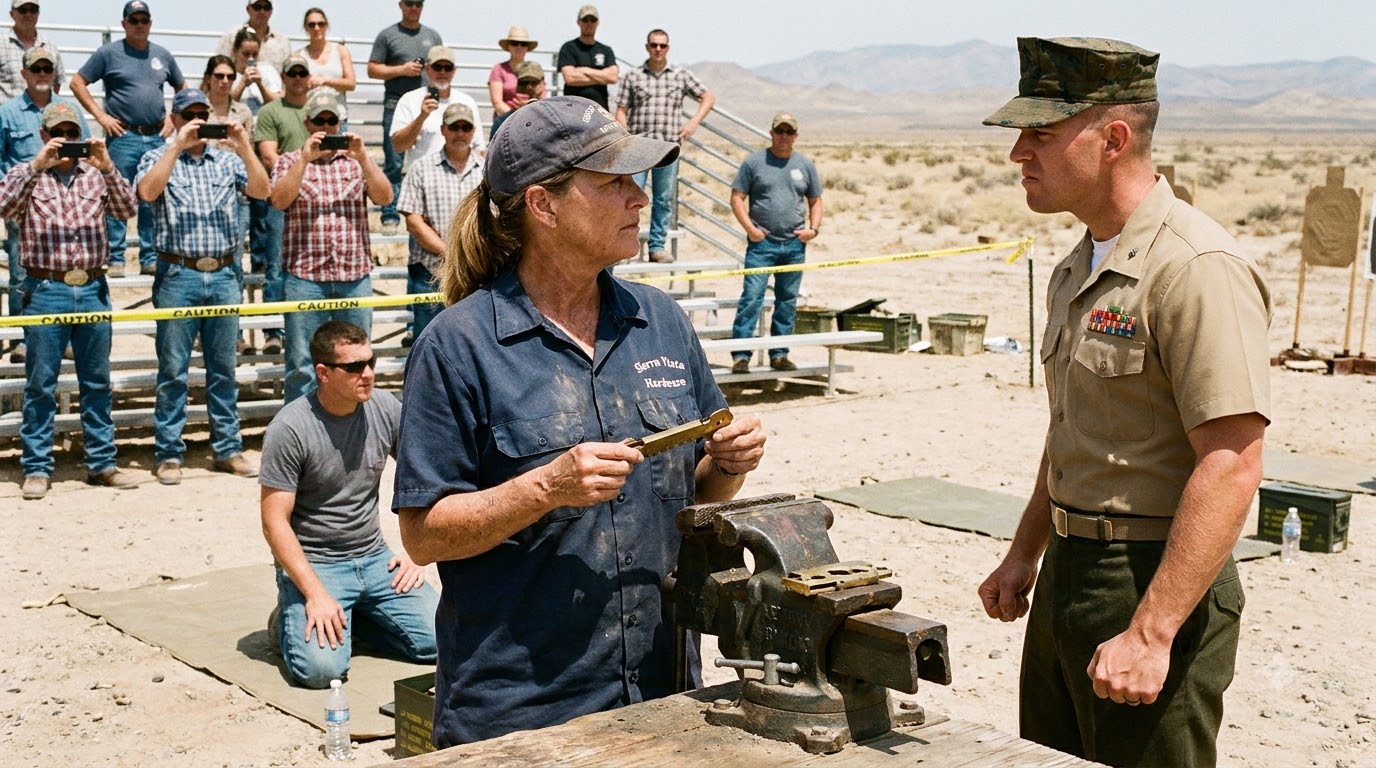
Instead, I picked up the small, worn brass thread pitch gauge from the table edge and stepped past the caution tape toward the range bench vise—the heavy cast-iron clamp where the unit mounted receivers for maintenance. Vance noticed me moving out of the corner of his eye and pivoted sharply, his jaw tight.
“I told you to clear the line, miss,” Vance said, his voice dropping into a low, deliberate growl. “You don’t touch military property.”
“I’m not touching your rifle, Captain,” I said, my voice steady as a plumb line. I pointed the brass edge of my gauge at the bench vise’s mounting rail. “I’m looking at your maintenance gear. Look at the cross-bolt on that clamp.”
A few spectators in the front row leaned over the rope, their eyes following my finger. Vance blinked, instinctively glancing down at the heavy iron vice bolted to the wooden bench.
Right where the receiver rail locked into the vise jaws, a tiny, jagged flake of gray metal stuck out from the threaded cross-bolt. It wasn’t steel. It had the dull, brittle sheen of cheap zinc alloy—a metal that had no business being on a military-grade armorer’s station.
“That’s just metal shavings from normal wear,” Vance said quickly, though a faint bead of sweat broke near his temple. “We clean these benches down every evening.”
“Zinc doesn’t wear off heat-treated steel receiver rails, Captain,” I said, running the brass gauge along the thread pitch of the vise bolt. The notches didn’t match. “This vise isn’t military specification either. It’s a cheap commercial knockoff with soft threading. When your boys clamp their rifles down to torque the optics, this soft zinc metal shears off and wedges into the rail grooves.”
The spotter, who was halfway into a prone position on the shooting mat, stopped. He looked at the cross-bolt, then up at Vance, his eyes widening slightly.
“Every time you fire, the barrel heat expands the steel,” I continued, letting the brass gauge drop back into my palm with a solid clink. “The zinc flakes melt slightly, shift under the recoil, and throw your mount out of alignment by a fraction of a millimeter. You’re not fighting the wind, Vance. You’re shooting off a broken bench.”
A collective murmur rippled through the bleachers behind us. Vance’s face flushed a dark, angry purple as he realized the crowd was no longer watching a demonstration of military precision, but a public mechanical audit.
“You’ve got a lot of mouth for a hardware clerk,” Vance spat, stepping directly into my space to block the crowd’s view of the vise. “You don’t know where this equipment came from, and you sure as hell don’t inspect my line.”
“I don’t need to inspect it,” I said quietly, meeting his glare without flinching. “The metal speaks for itself.”
CHAPTER 3: THE FRACTURED LINE
“Back behind the rope. Right now,” Vance said, his hand dropping to the leather strap of his sidearm holster. The action wasn’t a threat to draw, but it was the oldest trick in the book—weaponizing the uniform to scare a civilian into backing down.
I didn’t step back. I tapped the brass thread gauge once against the iron jaw of the vise, letting the metal ring out crisp and clear over the hum of the bleachers.
“You’re making a scene out of nothing,” Vance hissed, leaning down so only I could hear the sharp edge in his breath. “You think because you sell nuts and bolts at a counter down the road, you can walk onto my range and accuse my unit of using substandard gear? I’ll have range security escort you off the property for interfering with a military exercise.”
“It’s a charity fundraiser, Captain,” I said, looking him dead in the eye. “And your spotter knows I’m right.”
Vance’s head snapped toward the spotter, who was still kneeling by the shooting mat. The younger Marine looked down at his clipboard, suddenly very interested in the grass between his boots, unable to meet his commander’s eyes.
“She’s lying,” Vance declared, turning back to face the bleachers and raising his voice so the whole crowd could hear. “This woman is trying to cover up for the fact that she touched a bench setup without authorization. Any contamination on that vise came from her own hands.”
A few people in the bleachers shifted uncomfortably, but no one bought it. You don’t get zinc metal shavings embedded inside a hardened steel thread from holding a brass hand tool.
“Call the base armorer out here, Vance,” I said, holding my ground. “Let him bring his micrometer. If that thread isn’t soft zinc alloy, I’ll walk out of here and never mention it again.”
Vance’s jaw twitched. His right hand tightened into a fist at his side, knuckles turning white under the sun. “I don’t take orders from retail clerks. Range officer—clear this lane!”
The range officer hesitated, looking between Vance’s red face and the cold, unbothered posture I held beside the bench. Before he could step forward, a shadow fell across the gravel behind us.
“Is there a problem with the equipment, Captain?”
The voice was low, clipped, and carried the effortless weight of real authority. The Lieutenant Colonel stepped around the corner of the tent, his cover tucked neatly under his left arm.
CHAPTER 4: THE UNRAVELING THREAD
Vance snapped straight, his boots digging into the dirt as he brought his hand up in a tight, rigid salute. “Sir. Just handling a civilian disruption on the firing line.”
The Lieutenant Colonel didn’t return the salute immediately. His eyes traveled from Vance’s flushed neck down to the iron vise, then rested on my face. “I asked if there was an issue with the equipment, Captain.”
“No, sir,” Vance said, his voice tightening. “The civilian is making unsubstantiated claims about our bench setup to explain away the wind drift.”
I didn’t wait for permission. I reached down to the wooden ledge of the armorer’s station and pulled out the gray vinyl maintenance logbook tucked under the bench vise frame. Vance made a sudden, twitching movement toward me, but the Colonel’s silent, heavy glance held him in place.
“Look at the entry from three weeks ago,” I said, flipping open the grease-stained pages with one thumb. I held the open book toward the Lieutenant Colonel, pointing my brass gauge at the bottom line. “Four replacement vise assemblies signed in. No mil-spec serial numbers. Just a commercial invoice tag.”
The Lieutenant Colonel stepped closer, squinting at the thin blue ink. A single bead of sweat rolled down Vance’s jawline, hanging suspended for a second before dropping onto his starched collar.
“That’s just temporary shop inventory, Colonel,” Vance stammered, his posture stiffening even further. “Our primary bench gear was sent for scheduled maintenance.”
“Then why does this commercial tag carry a regional procurement stamp signed off by your unit’s log officer?” I asked, tapping the brass gauge against the paper. “This zinc-plated hardware costs twelve dollars at a civilian supply yard. Your log shows a charge of four hundred dollars a unit.”
A cold silence dropped over the shooting line. The spotter lowered his binoculars completely, staring at the logbook as if it had caught fire.
“You’re out of line!” Vance shouted, his composure shattering as he stepped toward me, his hands shaking with cold rage. “You have no standing to question unit procurement!”
“I don’t care about your budget, Vance,” I said, my voice dropping to a harsh whisper that cut through his shouting. “I care that you clamped your shooters’ receivers into zinc jaws that shear apart under heat, then blamed twenty-year-old corporals for missing steel when your own mounts were loose.”
The Lieutenant Colonel reached out and took the logbook directly from my hand, his knuckles gray against the vinyl cover as he read the signature at the bottom.
CHAPTER 5: THE SYSTEMIC CHECKMATE
“Explain this signature, Captain,” the Lieutenant Colonel said, his voice dropping into a register that made the surrounding Marines go completely still.
Vance swallowed hard, a muscle in his cheek twitching as he looked around at the spectators pressing against the rope. “Sir—procurement handles bulk requisitions across the entire district. I don’t inspect every shipping crate that arrives at the armory.”
“You signed the installation verification entry three days ago,” I said, pointing the tip of my brass thread gauge at the bottom line. “And you didn’t need a microscope to see what you were bolting onto these benches.”
I reached into my apron pocket, pulled out a small, battery-operated heat gun used for electrical tubing at the hardware store, and plugged it into the extension cord running to the vendor tent behind us. Vance lunged forward half a step, his arm sweeping out to block me.
“She’s tampering with the setup!” Vance yelled, turning to the Colonel with wide, desperate eyes. “Colonel, this is an active range! She’s bringing uninspected civilian tools onto a military station!”
“Let her work, Captain,” the Lieutenant Colonel commanded quietly. “And take a step back.”
Vance stopped mid-stride, his chest heaving, teeth clenched so tight his jawline bulged. I flipped the heat gun’s switch. The high-pitched whine of the element cut through the desert quiet.
I held the hot air stream four inches from the bench vise’s cross-bolt for ten seconds. The dull, gray zinc flake wedged in the steel threads didn’t just expand—it began to soften, glistening as the heat broke down the cheap alloy binding.
I pressed the flat notch of my brass gauge against the cross-bolt and applied light pressure. The threaded rod shifted sideways with an audible, greasy pop, slumping three millimeters out of true alignment right before the Colonel’s eyes.
“That’s twenty-five MOA of drift without a single grain of powder burned,” I said, shutting off the heat gun. The sudden silence hit the range like a heavy weight. “Every time your boys fire a string, the barrel heat melts the zinc seating on these knockoff clamps. They aren’t bad shots, Colonel. They’re shooting off hardware that degrades every time the trigger is pulled.”
The Lieutenant Colonel looked from the slumping vise bolt to Vance. Vance opened his mouth, but no sound came out—only a dry, desperate gasp as the full weight of the paper trail locked around his neck.
CHAPTER 6: THE DUSTY QUIET
Vance’s hands twitched toward his belt, his posture slumping as he tried one last, desperate angle. “Colonel, she used an unapproved heating element on base gear—she altered the physical state of the bench! This isn’t a valid test, it’s sabotage!”
“Shut your mouth, Captain,” the Lieutenant Colonel said. His voice wasn’t loud, but it cut through Vance’s panic like a blade through wet cardboard. He didn’t look at Vance. He looked down at the soft zinc deformity oozing out of the iron vise threads.
“Range officer,” the Colonel called out calmly. “Shut down Lane Four. Tag every bench vise on this line for immediate impoundment and forensic audit. Captain Vance is relieved of range duties effective right now.”
Vance stood frozen, his mouth open, swallowing hard as two military police officers stepped forward from the rear tent line. He looked at me—a hardware clerk in a faded navy cap holding a twelve-dollar heat gun—and realized there was no speech left to make, no rank to hide behind, and no audience left to fool.
The spotter quietly packed his notebook into his vest pocket, giving me a short, respectful nod as he stepped off the mat. The crowd in the bleachers began to break up, the quiet hum of murmuring voices replacing the tension that had held the range all morning.
I unplugged the heat gun, coiled the thick yellow extension cord around my elbow, and dropped my brass thread pitch gauge back into my apron pocket. I didn’t wait for a formal thank you, and I didn’t linger to watch Vance hand over his sidearm to the shore patrol.
The desert sun was already dipping low, painting the long flats in streaks of dry copper and pale red as I walked across the gravel lot toward my old Ford pickup. The dust on my boots felt clean.
Monday morning came before the town even blinked awake. The bell above the door at Sierra Vista Hardware chimed soft and clear as Mr. Dale pushed open the front glass.
I was already behind the counter, my thumb tracing the smooth, oiled wooden handle of a stock broom as I swept sawdust into a neat pile near the front bin.
“Morning, Tessa,” Mr. Dale said, hanging his cap on the wall peg. He didn’t ask about the range, and he didn’t mention the news snippet circulating on the local radio about an investigation at the base armory. He just looked at the neatly sorted rows of grade-eight steel bolts on the wall behind me.
“Morning, Mr. Dale,” I said, setting the broom against the counter. I picked up a fresh box of brass washers and began sliding them onto the display peg, one by one, steady and quiet in the morning light.