
The Weight of Silence: How a Young Seal Learned the Cost of Disrespecting a Forgotten World War II Hero
CHAPTER 1: THE QUIET TABLE
The air in the naval base mess hall smelled of stale coffee, industrial floor wax, and fried grease.
Around the long laminate tables, young sailors leaned into their lunch trays, voices overlapping in a dull, steady roar of routine friction.
Henry Cole sat near the corner, his straight back untouched by the slouch of age, his fingers wrapped steadily around a worn ceramic mug.
A bead of condensation slid down the side of the cup, leaving a damp ring on the gray tabletop.
Across the room, the sharp clatter of a dropped fork went entirely unnoticed beneath the laughter of a half-dozen active-duty SEALs gathered near the condiment station.
Petty Officer Jack Reynolds broke away from the group, his tray balanced casually in one hand, his jaw set with the easy confidence of a man who believed the world operated strictly by his current rank.
He caught sight of the old man’s jacket—frayed at the cuffs, carrying a small, oxidized metal pin pinned directly over the left pocket.
Reynolds stopped three feet from the table, his shadow falling directly across Henry’s plate.
“Hey, old man,” Reynolds said, his voice cutting through the ambient clatter with deliberate coldness. “What rank did you hold back in the stone age?”
A low ripple of laughter flickered behind him, quick and dry.
Henry did not look up from his tray.
He lifted a spoonful of soup, his hand moving with a slow, mechanical precision that ignored the intrusion entirely.
“I’m talking to you,” Reynolds pressed, stepping closer until his boots brushed the edge of the linoleum table leg. “This is a military installation. Civilians don’t just wander in here for lunch. Where is your identification?”
The conversation at the adjacent tables died away in increments.
Forks slowed, hovered mid-air, and settled back down onto trays as the room’s collective breathing hitched.
Henry set his spoon down.
It made no sound against the ceramic bowl.
He did not rush his movements, nor did he shrink away from the height advantage pressing down upon him.
Reynolds reached out, his fingers tapping sharply against the edge of the laminate.
“I don’t have all day, old timer. Show me your ID, or we’re going to have a problem.”
Henry slowly raised his head, his eyes calm, flat, and entirely unreadable.
CHAPTER 2: CROSSING THE LINE
Reynolds leaned closer, his chest expanding as he sought to fill every inch of available air space between them.
The low hum of the mess hall chatter thinned out, replaced by the sharp scrape of a boot heel against the linoleum.
Henry didn’t blink.
He didn’t pull his hand away, nor did he offer the compliance that the younger man’s rank-inflated ego demanded.
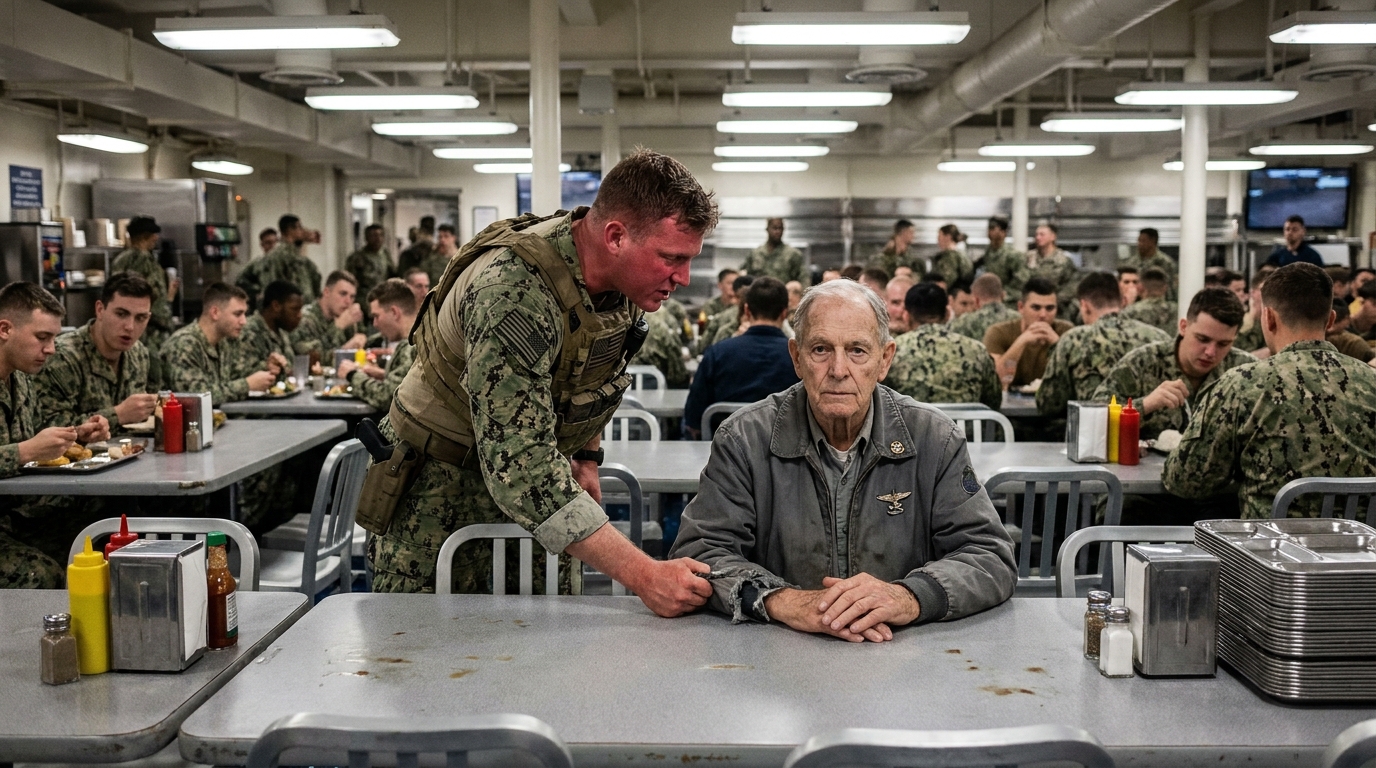
“I asked you a question, old man,” Reynolds muttered, his fingers tightening over the fabric of Henry’s sleeve. “You don’t get to sit here and play deaf while I’m speaking to an officer.”
The fabric pinched sharply against the skin of Henry’s forearm.
It was a clumsy application of dominance, born of a man who had never learned that true authority required no volume.
A few feet away, Seaman Lucas Parker gripped the edge of his metal tray so hard his knuckles turned white, his eyes locked on the spot where Reynolds’s fingers bit into the gray jacket.
Henry let out a slow, measured breath through his nose.
He didn’t raise his voice to match the rising temperature of the room.
“You’re holding on pretty tight to something that isn’t yours,” Henry said. His voice was raspy, carrying the dry, unhurried cadence of someone who had watched storms pass over deeper trenches than this one.
Reynolds flushed a mottled red, his grip tightening until his knuckles cracked.
“You’re disrupting base security, and you’re going to stand up right now or I’ll drag you out myself.”
The silence in the mess hall grew brittle.
No one stepped forward, and no one turned away; the invisible boundary of the SEAL trident had paralyzed every higher-ranking officer and enlisted man within twenty feet.
Reynolds gave the thin arm a sharp, deliberate yank, attempting to force the old man upright by sheer physical momentum.
Henry didn’t fight the pull with muscle, but he didn’t rise either; he simply let his body weight anchor into the chair, turning the jerk into an awkward, unbalanced tug that made Reynolds stumble forward a half-step.
CHAPTER 3: THE HEAVY CALL
The plastic shell of the receiver felt slick beneath his palm, slick with the cold perspiration of a man standing on the edge of a precipice.
Across the room, the unmistakable shadow of Petty Officer Reynolds loomed larger over the corner table, his hand still clamped tight around Henry Cole’s thin sleeve.
Lucas swallowed hard, tasting the dry copper tang of fear in the back of his throat.
An old memory surfaced unbidden—his grandfather standing in a crowded grocery aisle years ago, hands shaking, labeled a nuisance because he moved too slow for an impatient world.
Young Lucas had stared at his shoes then, choosing silence, choosing the cowardice of looking away.
He refused to let that ghost replay itself across these gray tiles.
“Command Master Chief’s office,” a clipped voice barked through the earpiece. “State your business.”
Lucas pressed the receiver tighter against his ear, his eyes locked on the spot where Reynolds was attempting to haul the seated veteran upright.
“I need to speak with Master Chief Donovan immediately,” Lucas said, his voice dropping into a hard, hurried register. “There’s an emergency in the main mess hall.”
“The Master Chief is occupied,” the voice responded, flat and dismissive. “Submit a report through your duty officer.”
“No—listen to me,” Lucas whispered fiercely, his gaze flicking back to the tables where everyone else sat frozen, paralyzed by the golden trident. “A SEAL is actively harassing a World War II veteran. He’s laying hands on him right now.”
A sharp pause stretched across the line, heavy and abrupt.
“Who is the civilian?” the voice demanded, stripping away all routine bureaucracy.
“His name is Henry Cole,” Lucas said, his knuckles turning white against the plastic. “Reynolds has him by the arm. He’s trying to drag him out.”
The line didn’t click dead; instead, it filled with the sharp, violent scrape of a heavy metal chair shoved violently back against a desk.
“Where are you?” Donovan’s voice returned, compressed to a dangerous whisper.
“Base mess hall, sector four,” Lucas replied, his breathing shallow. “He’s still sitting there, Master Chief. But he won’t take much more.”
“Keep your eyes on him,” Donovan ordered, each word landing like an iron rivet. “Do not let him out of your sight. We are moving now.”
CHAPTER 4: THE ARRIVAL OF COMMAND
The midday heat of the crowded room seemed to drop ten degrees the instant the base commander crossed the threshold.
Master Chief Donovan moved in right behind him, his boots clicking against the concrete floor in a sharp, unbroken rhythm that commanded total obedience.
Behind them both stepped Admiral James Harper, his white uniform crisp and spotless under the flickering fluorescent lights.
Every enlisted man and officer in the room snapped to a rigid, instinctive position of attention.
Plates rattled softly as trays shifted, but no voice broke the sudden, suffocating silence.
Reynolds remained standing by the corner table, his hand still awkwardly hooked around Henry Cole’s sleeve, completely paralyzed by the three silver stars gleaming on the admiral’s shoulders.
Admiral Harper didn’t scan the room or search for faces; he walked straight ahead with an unhurried, devastating momentum.
A cold bead of sweat traced a slow path down the back of Reynolds’s neck as the distance between them evaporated step by measured step.
“Let go of his arm, Petty Officer,” Harper’s voice cut across the vast space, quiet, flat, and absolute.
Reynolds flinched as if struck by a live wire, his fingers snapping away from the frayed jacket fabric in frantic haste.
The admiral stopped directly in front of the small table, looking down at Henry Cole with a gaze carved out of pure history.
Without a word of command, Harper’s heels clicked together, his right hand rising sharply to the brim of his cover in a flawless, formal salute.
CHAPTER 5: UNVEILING THE PAST
The palm of Admiral Harper’s hand remained rigid against his brow, framing a silence so heavy that even the distant hum of the galley vents seemed to vanish.
Reynolds stood frozen several paces away, his fingers twitching uselessly at his sides as the blood drained entirely from his face.
“At ease, Admiral,” Henry said quietly, his hand rising just enough to gesture a return to normalcy.
Harper lowered his arm with slow, deliberate precision, his eyes never leaving the weathered face of the seated man.
“I apologize for the disturbance, sir,” Harper said, his voice carrying clearly across every silent table in the room. “No man under this command has any business forgetting who laid the foundation we walk upon.”
A low murmur rippled through the enlisted ranks, bouncing off the concrete walls like distant thunder.
Reynolds swallowed hard, his throat tightening into a dry knot as he realized the magnitude of his error.
Master Chief Donovan stepped forward, his gaze locking onto the terrified junior officer with a cold, unblinking focus.
“You asked for identification, Petty Officer,” Donovan said, each word dripping with iron. “You demanded to know who gave him the right to sit in this facility.”
Reynolds opened his mouth, but no sound came out; his career, his rank, and his arrogant certainty crumbled into dust beneath the weight of those two sentences.
“This man is Henry Cole,” Donovan continued, turning his shoulders to face the wider room. “A World War II frogman from an era before the trident was even forged into a symbol.”
The air grew denser still as the historical truth settled over the mess hall like an unyielding anchor.
“His unit went behind enemy lines on a mission that failed,” Harper added, taking a half-step closer to the table. “Most of his team didn’t make it past the first twenty-four hours.”
Reynolds stared at the floor, his boots suddenly feeling like lead weights as the devastating reality of those forgotten days took root in his mind.
“He stayed behind alone for three days,” Harper said softly, his voice dropping an octave as he looked down at the oxidized insignia pinned to Henry’s frayed jacket. “No support, no extraction route, no backup. He finished what his team started.”
The admiral pointed a steady finger directly at the small metal pin resting over Henry’s pocket.
“That is not a souvenir,” Harper concluded. “That is the original badge of his unit, handed to him by his team leader minutes before that man fell in the mud.”
CHAPTER 6: THE LONG WALK BACK
Reynolds did not look up when the base commander issued his immediate directives.
His demotion was recorded swiftly, accompanied by an official mandate to reopen his service record and study the unwritten history of those who had walked before him.
Weeks bled into the routine hum of base operations, the friction of discipline wearing down the sharp edges of his unearned pride.
When Reynolds finally sought out Henry Cole, he wore no insignia of authority, carrying only the heavy, quiet burden of a lesson learned in absolute stillness.
He found the old veteran sitting on a weathered wooden bench near the edge of the tarmac, watching the distant gray horizon.
“Sir,” Reynolds said quietly, stopping a respectful distance away without attempting to bridge the gap with false confidence.
Henry turned his head slowly, his expression devoid of condemnation or triumph.
“Sit down,” Henry said, patting the worn wood beside him.
Reynolds lowered himself onto the bench, resting both hands flat on his knees, his gaze fixed on the dirt between his boots.
“You have two ears and one mouth,” Henry said, his voice raspy and steady against the wind. “Use them in that proportion.”
Reynolds nodded once, a sharp, clean movement of acceptance.
He didn’t offer excuses or justifications for what had happened in the mess hall weeks prior.
Instead, he listened as Henry spoke of names that existed only in fading memories, of the heavy cost carried by a small metal pin, and of the invisible foundation that supports every man who wears the uniform.
Honor was never found in a loud voice or an inflated rank; it lived entirely in remembering who built the path and how one treats those who walked it first.
As the sun dipped lower behind the tarmac, Reynolds stood and raised his right hand in a final, unforced salute.
Henry returned the gesture with a calm, weathered nod, and nothing more needed to be said.
Later that evening, the base settled into its quiet, ordinary rhythm, stripped of tension, leaving only the steady hum of a new normal where every step forward was measured by the weight of the past.