The Weight of the Acre: How a 19th-Century Homestead and a Stubborn Farmer Taught an HOA Queen the Price of Ground
CHAPTER 1: The Weight of the Cedar Post
The cedar post was rotted two inches below the frost line, gray as a winter sky and stubborn enough to break a modern spade. Arthur drove the iron spud bar into the dry earth with a dull, heavy thud that rattled up through his forearms, feeling the resistance of the hardpan underneath. Fifty acres of dirt that had been cleared with mules and sweat back when the candles were tallow and the nearest town was three days away by wagon. Now it smelled faintly of fresh-cut asphalt and chemically treated suburban lawns that ended precisely where his weeds began.
He wiped a forearm across his forehead, smearing a streak of red clay over his brow, and looked up as the crunch of gravel signaled an approach. It wasn’t the mail truck, and it wasn’t the delivery van that missed the turn twice a week. It was a pair of running shoes stopping just short of the grass line—clean, white mesh with soles that had never touched a cow path.
“Excuse me,” a voice said. It was smooth, pitched slightly higher than necessary to carry over the ambient hum of the cicadas.
Arthur didn’t drop the spud bar. He leaned his weight against it, resting his palms on the pitted iron handle, and turned his head slowly. The man standing across the rusted wire was wearing a pastel polo shirt tucked so tightly into his pleated shorts it looked painful. A golden retriever stood beside him on a retractable leash, its tongue lolling out, sniffing the air with mild confusion as the breeze shifted from the direction of the old pig barn.
“Morning,” Arthur said. The word came out flat, worn down by forty years of talking to weather reports and balky tractor engines.
“I’m Greg,” the man said, offering a tight, manufactured smile that didn’t reach his eyes. He gestured vaguely toward the sprawling expanse of the western meadow where the goldenrod was going to seed. “From the new build across the lane. Phase Four, lot twelve. Just walking Buster before it gets too hot.”
“Arthur.” He didn’t offer a hand; both of his were stained black with creosote from the fence line.
“Beautiful property,” Greg said, squinting against the glare bouncing off the rusted tin roof of the machinery shed. “We were just talking at the association meeting last night about how wonderful it’s going to be when the whole block is opened up. The landscaping committee has some incredible concepts for the walking paths through here.”
Arthur’s fingers tightened slightly around the cold iron of the spud bar. The silence between them stretched, thick with the sound of a distant lawnmower drone from the subdivision.
“Walking paths,” Arthur repeated, his voice dropping into that quiet register that usually made feed salesmen check their order books twice.
“Well, yes. Once the transition goes through,” Greg laughed, an uneasy, jittery sound. “The president— Brenda—she’s been spearheading the acquisition talks with the county board. Everyone’s thrilled. Especially with the community garden and the open-air pavilion planned right where those old pig pens are. Saves us all a fortune in membership fees at the country club.”
The golden retriever gave a short, sharp bark, pulling at the leash as a rooster let out a raspy, challenge-filled shriek from the shadow of the tractor shed.
Arthur stared at the man, watching the way the sunlight caught the perfect alignment of his hair part, and felt the slow, heavy rise of iron-cold certainty in his chest. Brenda hadn’t just been complaining about the noise; she had been drafting a map of a world that didn’t belong to her.
“There ain’t no transition, son,” Arthur said quietly, pulling the bar out of the earth with a wet suction sound. “And if Brenda told you different, she bought herself a bridge that don’t cross no water.”
Greg’s smile faltered, his eyes dropping momentarily to the heavy iron bar in Arthur’s hand before snapping back up, the polite facade cracking just enough to show the panic underneath.
CHAPTER 2: The Ultimatum Across the Hood
The silence between them did not stretch; it sagged, heavy with the weight of unshared history and concrete calculations. Greg’s throat moved as he swallowed, his fingers tightening involuntarily on the nylon tether until the golden retriever gave a low, questioning whine and sat back against the manicured turf of Phase Four.
“Brenda’s got the county filings,” Greg said, his voice losing that bright, civic-association cadence and dropping into something thin and defensive. “She showed us the plat maps at the orientation meeting last month. Said the acreage was slated for municipal conversion under the county’s green-space expansion act. Said you were just… holding out for a nuisance payout.”
Arthur didn’t blink. He kept his weight braced against the spud bar, his gaze locked on the pristine white of the man’s polo shirt. Beneath his boots, the earth felt solid, the same hardpan clay his grandfather had cursed when breaking horses here in the summer of nineteen-forty-two. A sudden, sharp memory flared behind Arthur’s ribs—the smell of wet horse lather, the rhythmic rasp of a crosscut saw down by the creek, and his grandfather’s voice barking over the sound of running water: They can map all they want on paper, boy, but paper dissolves in the first good flood. Water remembers where it belongs.
“A nuisance payout,” Arthur repeated quietly. The words tasted like dry chaff. “Tell me, Greg. Did Brenda happen to mention who cleared the drainage ditches along the north ridge back when this whole valley was a swamp?”
Greg shifted his weight, his sneakers grating against the fine gravel of the path. “That’s… that’s a municipal matter now. The development board handled the zoning adjustments with the county commissioners back in November. It’s all legal.”
“Legal,” Arthur said, and the corners of his mouth twitched into something that wasn’t quite a smile. “Son, you can file a piece of paper that says a pig is a racehorse, but you’re still going to end up covered in mud when you try to saddle it. Brenda’s been waving a colored map she printed off a county planning portal, ain’t she? Showing you little colored squares where my machinery shed’s sitting?”
Greg didn’t answer. The absolute stillness in his face was confirmation enough. He had seen the lines drawn across Arthur’s pasture on a glowing laptop screen in an air-conditioned subdivision clubhouse, far away from the heat and the dust and the hard truth of fifty rusted acres.
“She’s got a committee meeting this afternoon at three,” Greg muttered, looking down at his shoes as if noticing the dust blowing over from the plow line for the first time. “She said the site survey for the summer pavilion is locked in. Caterers are already booked out of the city. One hundred and twenty-five plates.”
“One hundred and twenty-five plates,” Arthur said, the numbers rolling off his tongue like inventory on a feed bill. He pulled the spud bar out of the earth with a wet, sucking sound, the iron sliding free of the clay. “Well, that’s a lot of folks to feed out in the open sun without a proper permit from the health department. Hope they like flies.”
“Look, Arthur—can I call you Arthur?—let’s not make this difficult,” Greg said, stepping half an inch closer to the property line before the smell of fertilizer and old straw hit him like a physical wall and made him recoil. “The neighborhood association is willing to look into a landscaping stipend. A buffer zone of arborvitaes along your fence line so you don’t have to look at the new homes, and maybe a cash settlement for the early-morning rooster noise.”
Arthur rested the iron bar against his shoulder, his eyes fixed on the distant line where the asphalt gave way to red dirt. “You go on back to your committee meeting, Greg. You tell Brenda that the fence post is set, and the boundary line hasn’t moved an inch since the grant deeds were signed under President Grant. And if she wants to bring one hundred and twenty-five strangers onto my dirt this Saturday, she better make sure they’ve got good boots. Because the ground out here has a long memory.”
Greg opened his mouth as if to offer another corporate talking point, thought better of it, and gave a stiff, awkward nod. He yanked the leash, turning the golden retriever around so fast the animal stumbled on the grass. As they hurried back toward the symmetrical pastel houses of Phase Four, Arthur didn’t watch them go. He turned his attention back to the line of rotting posts, knowing precisely what time the mail truck arrived, and knowing exactly which county offices opened at eight o’clock Monday morning.
CHAPTER 3: The Paper Trail and the Bureaucracy
The air in the county records room smelled of wet limestone, decaying rag-fiber paper, and thirty years of floor wax that had long since surrendered to dampness. Overhead, a fluorescent tube flickered with a low, rhythmic hum, casting a jaundiced glare over rows of heavy green metal filing cabinets that lined the cinder-block walls.
Arthur did not sit at the laminate table near the intake window. Instead, he stood before row four, section twelve, his fingers tracing the cold brass handle of a drawer marked Deeds: 1820–1850. The metal was pitted and cold, offering a sharp, tactile contrast to the humid heat of the July morning outside. He pulled the drawer open with a deep, protesting screech of dry steel bearings.
At the front of the drawer lay the original patent deed—yellowed vellum stiff as sun-cured leather, signed in iron gall ink that had faded to a deep, bruised purple. It mapped out the metes and bounds of fifty acres defined by ancient white oaks, stone cairns, and the centerline of the creek that still meandered along his eastern pasture.
“Find what you’re looking for, Mr. Callahan?”
The voice came from behind the high counter near the exit. Mrs. Gable, a woman whose bifocals seemed permanently glued halfway down her nose, peered over her computer monitor with the weary patience of someone who had spent four decades watching people argue over where their fences didn’t belong.
“Just checking the plumbing, Mrs. Gable,” Arthur said, not looking up from the vellum. He carefully slid the heavy document out and laid it flat on the pull-out wooden shelf. “Old pipes tend to leak if somebody reroutes the main valve without telling the property holder.”
Mrs. Gable sighed, a sound like dry leaves scraping across asphalt, and pushed herself back in her squeaking swivel chair. She stood up, smoothing the front of her floral-print blouse, and walked over to the low swinging gate that separated the public floor from the archive desks. In her hands, she carried a thick blue binder labeled Phase Four Master Plat & Annexation Approvals.
“Brenda Vance was in here three weeks ago,” Mrs. Gable said quietly, tapping the corner of the blue binder against her knuckles. She didn’t offer the book, but she held it where Arthur could read the embossed gold lettering on the spine: Oakridge Estates Improvement District. “Filed a preliminary site alteration request for the western drainage swale. Claimed it was slated for municipal park conversion under the 2018 county green-space expansion ordinance.”
Arthur’s eyes narrowed, tracking the neat, typed lines of an annexation addendum visible through the open plastic sleeve. “She filed an alteration request for my back meadow?”
“She filed an application,” Mrs. Gable corrected, her tone dropping into professional neutrality. “Which requires written consent from the deeded landholder, tax clearance certificates, and a certified boundary survey signed by a licensed surveyor. Which, as you can see if you look at page fourteen, she didn’t attach. She attached an unverified graphic printout from the public GIS portal.”
Arthur reached out, his calloused thumb gently tracing the edge of the vellum deed before resting on the heavy wax seal of the territorial governor who had countersigned his great-grandfather’s patent. “And the county accepted an unverified printout?”
“The planning commission’s been rubber-stamping phase expansions since the boom started three years ago,” Mrs. Gable said, her gaze drifting toward the empty hallway outside. “They look at a colored map showing green trees and walking paths, and they see tax revenue. They don’t check the frost lines or walk the fences. But a map ain’t a deed, Arthur. And a municipal planning draft doesn’t override a water-rights easement recorded back when the state was still a territory.”
Arthur paused, his hand freezing above the metal edge of the drawer. The words hung in the stale basement air, quiet and absolute. Water-rights easement. He remembered his grandfather talking about the old mill race upstream—the legal covenant that required the lower acreage to maintain the drainage flow for the entire watershed, tying the fate of any upstream development directly to the integrity of his land. If the developers built over his meadow without accounting for the natural spring-fed runoff, the entire subdivision’s storm retention system would back up into their own pristine, manicured basements within twenty-four hours of a heavy rain.
“Does Brenda know about the easement?” Arthur asked softly.
Mrs. Gable gave a dry, humorless chuckle, adjusting her glasses on the bridge of her nose. “Brenda only reads what prints out in color and makes her look like a pioneer. She thinks paperwork is something you sign to make people go away.”
Arthur closed the metal drawer. The latch clicked shut with a solid, definitive snap that echoed off the cinder-block walls. He reached into his canvas work jacket, pulled out a small, folded leather notebook, and jotted down three docket numbers from the spine of Mrs. Gable’s binder.
“Appreciate it, Martha,” Arthur said, tipping the brim of his straw hat.
“You make sure you file your counter-notice before Friday noon, Arthur,” she called out as he turned toward the heavy glass exit doors. “If you don’t object in writing to the board’s docket before the hearing, they’ll claim administrative default. And once they get a default judgment, getting heavy machinery off your dirt requires a court order that takes six months to process.”
Arthur pushed through the glass doors, stepping out from the air-conditioned tomb of the courthouse straight into the white-hot glare of the midday sun. The asphalt in the parking lot radiated a tangible wave of heat that shimmered against the fenders of parked sedans. He climbed into the cab of his rusted flatbed truck, turned the key until the diesel engine coughed to life with a deep, rattling roar, and pointed the hood back toward the fifty acres of stubborn land waiting at the edge of the subdivision. The paperwork was in motion, but the real work—the heavy lifting of iron and water—wouldn’t start until the sun went down.
CHAPTER 4: The Iron and the Pond
The interior of the shed smelled of scorched belt rubber, oxidized iron filings, and thirty years of accumulated diesel soot. Shafts of sunlight cut through the dusty gloom like golden blades, illuminating floating motes of chaff and the bulky silhouette of the John Deere tractor parked against the back wall.
Arthur did not turn on the overhead lights. He walked straight to the corner where the old PTO-driven manure spreader sat on its rusted, high-clearance steel wheels, its wooden sideboards weathered to a silver-gray that matched the surrounding siding. It was a utilitarian machine, heavy, unpretentious, and smelling faintly of the organic layers accumulated from decades of working fifty stubborn acres.
He knelt beside the tongue hitch, picking up a heavy grease gun and a clean rag, his movements deliberate and unhurried. The plan wasn’t complicated, but it required precise mechanics. If Brenda was bringing one hundred and twenty-five guests in their white summer linen and designer sun hats onto his grandfather’s western meadow this coming Saturday, they needed a proper introduction to what fifty acres of working farm actually meant.
A sharp metallic clang echoed from the far corner of the shed, making him pause. Arthur didn’t flinch; he simply shifted his weight, keeping his eyes on the greasy pivot pin of the spreader axle. A field mouse darted across the floorboards into a pile of spare baling twine. The silence closed back in, thick and heavy, broken only by the steady dripping of a leaky connection near the old diesel tank outside.
He pumped the grease gun until a bead of dark, amber-tinted lubricant oozed from the joint, wiping away the excess with the rag. Then he stood up, his knees clicking in the quiet gloom, and walked over to the portable irrigation pump housed near the side bay.
The pump was a Briggs & Stratton motor bolted to a heavy steel frame, connected by a ten-foot reinforced intake hose dropped directly into the settling pond behind the barn. The water in that pond was fed by agricultural runoff and local tile drainage, possessing a distinct, earthy bouquet that settled deep into the fabric of any garment within fifty yards when the wind came out of the west.
Arthur checked the spark plug, pulled the starter cord halfway to feel for compression, and nodded to himself. The engine was sound. The intake lines were clear. All that remained was positioning the sprinkler heads along the rise of the ridge so that the afternoon prevailing breeze would naturally carry the fine, nutrient-rich mist straight across the boundary line toward where Brenda intended to set up her catered buffet tables and portable dance floor.
He reached for a rusted crescent wrench hanging from a nail on the timber post, turning it over in his calloused palm. This wasn’t malice, he told himself, sliding the tool into his jacket pocket. It was simply a matter of physics and land management. If you build your house too close to the barn, you have to expect the smell of the livestock to drift over when the wind changes. And if you plan a party on someone else’s property without asking permission, you have to be ready to pay the price of admission.
Arthur walked back to the sliding door, pulled it open just enough to let a wedge of hot afternoon light cut across the dirt floor, and looked out across the long, golden grass of the western meadow. The subdivision rooftops gleamed in the distance like rows of white teeth under the merciless July sun. Saturday was coming, and the old iron pump was primed and ready.
CHAPTER 5: The White Linens and the Rising Mist
The sun had barely cleared the eastern ridge by twelve feet when the white canvas pavilions blossomed across the western meadow like sudden, unnatural mushrooms. Arthur stood on the elevated wooden back porch of the farmhouse, a mug of black coffee cooling in his hand, watching the choreography of entitlement unfold below.
A refrigerated catering truck bearing city plates idled directly over the old tractor trail, its dual rear wheels crushing the wild mustard greens into the damp earth. Men in black aprons and white dress shirts scrambled back and forth between folding aluminum tables and a massive propane-fired roasting unit, snapping open folding chairs with crisp metallic clatters that carried clearly across the quiet acreage. Brenda stood near the center pavilion, dressed in a cream-colored linen blazer and oversized designer sunglasses, waving a clipboard like a field marshal directing an occupation.
Arthur took a slow, deliberate sip of the bitter coffee. The liquid was lukewarm, but it grounded him against the rising heat of the morning. His boots were laced tight; his canvas jacket was zipped to the collar.
A flutter of white paper caught his eye near the lower fence line where the mowed grass of the subdivision met his unkempt wire boundary. He walked down the porch steps, his boots crunching on the gravel path, and crossed the open yard until he reached the rusted fence posts. Caught on a barb of rusted wire was a discarded sheet of cardstock—a printed itinerary and guest list bearing the official letterhead of the Oakridge Homeowners Association. Site Fee Collected: $50 per guest. Total Capacity: 125. Below that, scrawled in hurried handwriting, was a note about municipal grant allocations tied to the “future municipal park space.” The paper was tangible proof of the unauthorized commerce happening on his deeded land, right down to the cash entry figures.
“Arthur!”
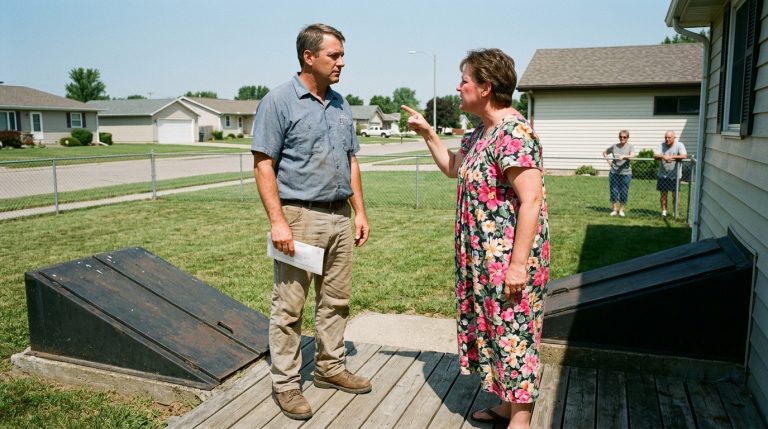
The voice cut sharp across the property line. Brenda had spotted him from beneath the edge of the primary canopy tent. She didn’t walk over; she stayed planted by the dessert table, her arm outstretched, pointing a manicured finger toward the farmhouse.
“You need to keep those chickens quiet for the next four hours,” she called out, her tone dripping with the forced patience of a manager addressing a recalcitrant clerk. “We have city council members and regional developers arriving at one o’clock. And make sure that old tractor of yours isn’t visible from the seating area. It completely ruins the rustic aesthetic.”
Arthur didn’t answer. He simply stared at her, his expression as flat and gray as a slab of unpolished granite. He let the silence stretch out, watching the way her jaw tightened beneath the designer sunglasses as she realized he wasn’t going to nod, wasn’t going to smile, and wasn’t going to bow to her schedule.
Without breaking eye contact, Arthur turned his back on her, walking past the garden gate and heading straight for the rusted iron frame of the old diesel irrigation pump housed near the shed.
The time for talking across fences had expired. It was one o’clock.
He reached down, wrapped his hand around the heavy braided starter cord, and pulled with his entire shoulder weight. The Briggs & Stratton motor coughed once, choked on a breath of rich exhaust, and then caught, roaring into life with a deafening, metallic shriek that echoed off the metal roof of the barn like a freight train barreling down an empty track.
Across the meadow, the symphony of polite chatter beneath the white tents abruptly shattered. Brenda spun around, her mouth opening in an exclamation that was instantly swallowed by the roar of the diesel engine. Arthur reached out, turning the primary brass valve on the intake line wide open, sending ten thousand gallons of pond-fed, nutrient-rich agricultural water surging through the overhead sprinklers just as the afternoon breeze shifted directly out of the west.
CHAPTER 6: The Blue and Red Lights
The transformation of the lawn party was instantaneous and absolute.
Beneath the primary canvas pavilion, the polite hum of suburban conversation cut out as if someone had pulled a master circuit breaker. Arthur watched from the threshold of the shed as a fine, microscopic veil of water droplets settled over the rows of pristine white linen tablecloths, the tiered silver dessert stands, and the shoulders of guests dressed for a garden gala in the Hamptons. The scent hit them first—an unmistakable, earthy bouquet of decaying pond reeds, sun-baked mud, and organic tile drainage that made several women in silk sundresses cough behind linen napkins.
Brenda dropped her clipboard. It hit the grass with a dull thud, right at the edge of a puddle forming beneath a recalcitrant sprinkler head. She spun around, her cream-colored blazer flashing in the midday sun, and pointed a trembling finger directly toward the tractor shed where Arthur stood framed in the doorway.
“Shut that down!” she screamed, her voice carrying across the fifty yards of open grass over the steady thrum of the Briggs & Stratton engine. “Turn that off right now! You’re destroying private property!”
Arthur didn’t move. He kept his hands hooked in his canvas jacket pockets, his weight balanced evenly on his work boots, watching her scramble across the damp turf toward the fence line with a squad of bewildered caterers trailing awkwardly behind her.
Before Brenda could reach the rusted wire, however, a sharper, more authoritative sound pierced the afternoon air. A pair of municipal vehicles—a white county sheriff’s cruiser and a red Ford pickup belonging to the district fire marshal—tore around the gravel bend of the subdivision access road with their light bars flashing in vicious bursts of red and blue. They didn’t slow down for the decorative stone entryway; they bounced across the unpaved shoulder and came to a skidding halt right on the edge of Arthur’s meadow, tires biting deep into the turf.
The driver’s side door of the cruiser swung open, and Deputy Miller stepped out, adjusting his duty belt with practiced ease. Behind him, Fire Marshal Vance hopped down from the truck, clipboard in hand, his eyes scanning the dense cluster of unpermitted propane heaters, commercial catering vans, and over one hundred people crammed beneath temporary canvas structures without a designated egress corridor.
Brenda changed vectors instantly, intercepting the deputy halfway across the grass with her hands raised in frantic protest. “Officer, thank goodness! You need to arrest that man immediately. He’s sabotaging a legally sanctioned community development event and threatening our guests with hazardous biological waste!”
Deputy Miller didn’t draw his sidearm, but he didn’t smile either. He looked past Brenda’s waving hands, his gaze locking onto Arthur, who was walking slowly down the gravel path from the shed toward the cluster of officials.
“Afternoon, Arthur,” Deputy Miller said, his voice flat and steady. “Got a call about a commercial gathering operating without county permits or municipal health sign-offs. We also got a trespass complaint filed under docket forty-two.”
“Afternoon, Tom,” Arthur replied, coming to a halt six feet away from the cruiser. He pulled a thick manila folder from beneath his arm—the same folder containing the original patent deed, the certified survey boundaries, and the timestamped email exchanges showing Brenda’s flat refusal to recognize his property rights. “Everything on this side of the cedar fence is deeded to my grandfather and recorded in eighteen-twenty-four. There ain’t a commercial permit filed with the county commissioners, and nobody on this crew has written permission to be operating a catering service or selling tickets on my land.”
Brenda’s face drained of color, her immaculate makeup suddenly looking like a harsh mask against her pale skin. “That’s a lie! The board has an annexation agreement under the municipal green-space expansion act. It’s community property!”
Fire Marshal Vance stepped closer, flipping open his inspection pad. “Ma’am, I looked at the master annexation registry this morning before I came out here. Phase Four ends twenty feet short of this fence line. You don’t have a municipal park designation, you don’t have a temporary assembly permit for one hundred and twenty-five people, and you certainly don’t have a fire marshal’s sign-off for those propane units tucked under canvas tents.” He clicked his pen shut with a sharp snap. “This event is shut down. Effective immediately. Everyone clears the meadow within fifteen minutes, or we start impounding the catering trucks.”
The silence that followed was broken only by the rhythmic, unbothered chug of the irrigation pump still running behind the barn. Guests began murmuring anxiously among themselves, hastily grabbing designer handbags, folding up lawn chairs, and retreating toward the safety of the paved subdivision streets. Brenda stood frozen in the center of the damp lawn, her mouth opening and closing as the foundation of her entire suburban empire dissolved beneath the weight of actual, unyielding law.
CHAPTER 7: The Aftermath and the Ledger
The flashing red and blue lights of the cruiser painted long, rhythmic arcs across the side of the metal equipment shed, casting a cold, strobe-like glare over the scattered debris of the aborted gala. Half-eaten canapés lay abandoned on linen-draped tables; empty champagne flutes caught the strobe effect like jagged shards of ice. Brenda sat in the driver’s seat of her pristine white SUV with the engine running, her knuckles white against the steering wheel as she stared straight ahead through the windshield, refusing to look at the deputies or the lingering caterers packing their equipment into metal flight cases.
Arthur remained standing near the edge of the crushed grass where the patrol car had parked, his hands tucked deep into the pockets of his canvas jacket. Deputy Miller walked back from the SUV, holding a triplicate carbon booklet and a yellow citation slip that fluttered slightly in the cooling afternoon breeze.
“She’s refusing to sign the municipal ordinance violations,” Deputy Miller said, his voice dropping into a low, conversational rumble as he stopped beside Arthur. He glanced toward the SUV, where Brenda’s window remained rolled up half an inch. “Fire marshal slapped her with a three-thousand-dollar fine for unpermitted mass assembly and blocked fire lanes. The catering company’s manager is out there screaming for payment, and the tent rental outfit is loading their gear back onto a flatbed without dropping a single pole.”
“She thought paper was something you sign to make folks go away,” Arthur said quietly, his eyes tracking the frantic movements of the men wrestling a heavy aluminum tent spar into the back of a utility truck.
“Well, the paper’s catching up to her now,” Miller replied, tapping the edge of the carbon book against his thigh. “County prosecutor’s office called my radio five minutes ago. When they pulled the property dockets for Phase Four this morning, they found out Brenda didn’t just file an unverified map—she used this acreage as collateral security for a neighborhood improvement grant through the regional housing authority. Pledged fifty acres she didn’t own to secure municipal matching funds for their subdivision tennis courts.”
Arthur didn’t flinch, though the slow burn in his chest tightened into iron certainty. The decoy secret of the forged boundary map was nothing compared to the financial anchor she had dropped around her own neck.
“Grant fraud,” Arthur said.
“Federal and state,” Miller confirmed, sliding the citation into his shirt pocket and securing the flap. “And since the development board’s bylaws explicitly state that the association president assumes personal liability for unauthorized financial encumbrances outside the recorded plat boundaries, she’s entirely on her own. The new board members already called a virtual emergency meeting twenty minutes ago. They’re voting to strip her presidency before sundown and draft a formal letter disavowing any connection to her land grab.”
Across the drying grass, the catering manager slammed the rear doors of his refrigerated truck with a deafening metallic bang that echoed off the barn wall. He marched directly toward Brenda’s SUV, pounding his fist twice against the driver-side window before shouting something that was muffled by the safety glass. Brenda didn’t roll the window down; she simply shifted the SUV into reverse, backed up in a tight, reckless arc that tore up two more yards of wild clover, and sped down the gravel access road toward the subdivision without looking back.
Arthur watched the white dust settle in her wake, the red taillights disappearing between the identical pastel houses of Phase Four. The meadow was quiet again, save for the steady, rhythmic chug of the irrigation pump still running behind the barn and the distant caw of a crow perched atop the rusted machinery shed.
“You going to turn that pump off, Arthur?” Miller asked, nodding toward the Briggs & Stratton engine.
“In a bit,” Arthur said, turning back toward the farmhouse porch. “The ground’s still thirsty.”
CHAPTER 8: Dawn and the New Routine
The morning sun cleared the eastern ridgeline in a long, unbroken stroke of amber light, touching the weathered cedar posts of the boundary fence before reaching the pristine, manicured lawns of Phase Four. Arthur stood on the elevated wooden back porch of the farmhouse, a ceramic mug of black coffee warming his palms. The air smelled of wet clover, cedar bark, and the faint, grounding scent of turned earth.
Down by the machinery shed, the old irrigation pump was silent, its intake hose resting quietly in the settling pond. But the water rights that anchored the entire valley remained firmly intact, a legally binding easement recorded in yellowed vellum that reminded every modern subdivision downstream that fifty acres of history could not simply be paved over with an unverified digital map.
A heavy, barred door slammed shut across the lane, followed by the dull thud of cardboard boxes being loaded into the trunk of a moving sedan parked in Brenda’s driveway. The white SUV sat idle and empty in the garage bay, its registration plates flagged by the county clerk’s office pending the final settlement hearings. The grant fraud investigation had moved swiftly once the HOA board produced the financial ledgers; Brenda’s attempt to leverage the farm as collateral had resulted in immediate receivership of her personal assets, court-ordered restitution to the ticket-holding residents, and a civil judgment that required her to pay every dollar of unpermitted site fees directly to the deeded owner of the land.
Arthur took a slow, deliberate sip of coffee, watching the movers carry a tall stack of plastic storage bins out toward the street. They moved with the sluggish, exhausted efficiency of people sorting through the wreckage of a failed enterprise.
A sharp, metallic rustle from the corner of the porch made him look down. A new wooden-handled drawknife, freshly oiled and sharpened to a razor edge, lay on the workbench beside a stack of seasoned cedar shims. His grandfather had used that very knife to fit the mortise-and-tenon joints of the original barn back when the valley was entirely wilderness. Arthur picked it up, running a calloused thumb lightly over the flat of the steel blade, feeling the cool, true balance of the tool.
With steady, unhurried motions, he knelt beside the loose corner board of the porch railing where a winter freeze had split the pine three years ago. Working entirely by touch and muscle memory, he carved a clean, custom shim from the seasoned cedar, tapping it gently into place with a small mallet until the joint locked firm and flush. The micro-repair was small, invisible from the lane, but it held the weight of the structure steady against the wind.
As he stood back up, wiping a fleck of wood shaving from his sleeve, a massive barred rock rooster stepped out from the shadow of the tractor shed, stretched its neck toward the pale pink sky, and let out a raspy, deafening crow that shook the morning dew from the overhead branches.
The sound rolled across the fifty acres, bouncing off the weathered barn walls and carrying straight over the cedar fence toward the edge of the subdivision. Across the lane, a second-floor window in the nearest house pulled shut with a sharp click.
Arthur took another sip of his coffee, a slow, quiet satisfaction settling deep into his chest. The boundary was marked, the iron was oiled, and the land was right where it belonged. He sat down on the wooden bench, listening to the morning settle into its natural rhythm, knowing that anyone who moved into the valley from this day forward would understand the simple, unalterable price of ground.