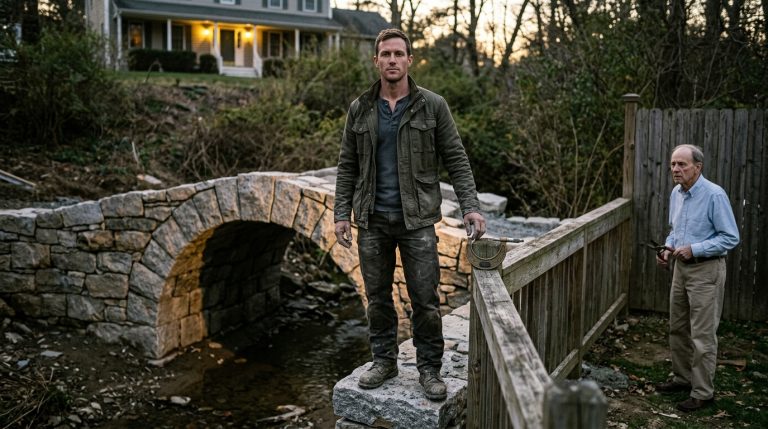
The Weight of the Dusty Gray: How a Quiet Widower and an Ancient Sentinel Dismantled a Neighborhood Tyrant Piece by Piece
CHAPTER 1: THE TREAD OF ENTITLEMET
The dry summer air carried the unmistakable scent of scorched rubber and cheap floral musk before the golf cart even crested the ridge. Jack held the hemp twine taut between calloused fingers, his thumb feeling the familiar fray of the knot. Behind him, the scarecrow—Silas—stood motionless on his wooden cross, his burlap sack head tilted slightly toward the southern boundary where the manicured lawns of Creekwood Estates bled like a green fungus against the natural grade of the valley.
“That grotesque effigy is a clear violation of section 9, subsection C of the Creekwood Estates covenants, conditions, and restrictions, and it has to go, Mr. Reed.”
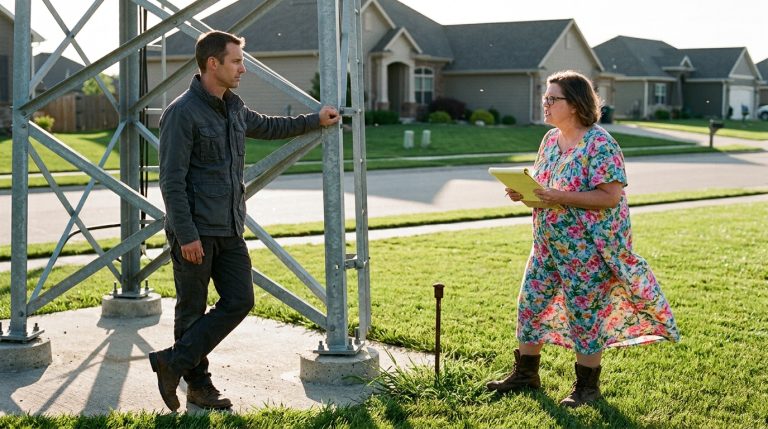
Karen Bishop stood at the edge of the unpaved boundary, her wide hips anchored by floral-print fabric that strained against the afternoon heat. Her hand rested on her hip, fingers tapping a nervous, rhythmic beat against her beltline. Beside her, Gary shifted his weight from sneaker to sneaker, his thin frame vibrating with the secondary panic of a man who lived to nod. The tires of the high-powered electric cart had carved deep, wet gouges into the damp earth of the tractor lane, fresh dark scars across the property line.
Jack did not turn immediately. He finished tying off the vine, securing the heavy stem to the stake with the methodical precision of an engineer checking a load-bearing cable. Only when the knot was tight did he rotate slowly on his heel, his eyes adjusting from the intricate web of twine to the imposing, blotchy face of the HOA president.
“You’re off your line, Karen,” Jack said. His voice was level, stripped of any rising inflection that might invite an argument. “Your jurisdiction ends at the Bradford pears. You know that, and the county plat map has listed this lot as agricultural-exempt since 1950.”
Her face shifted from an angry pink to a deeper, mottled plum. She thrust a glossy piece of paper forward, the printed violation notice fluttering slightly in the dry wind. “The board has authorized all necessary action to protect our property values. That junkyard aesthetic is dragging down the entire valley, and we won’t tolerate it.”
Jack looked down at the paper, then back to her eyes. He kept his hands at his sides, loose and ready, his weight balanced evenly over his boots. He had stared down worse than a suburban matriarch with a laminator, but the deliberate disrespect carved into the soil beneath her cart’s wheels hummed with a different kind of friction. This wasn’t about aesthetics. It was an initial probe, a test of boundaries to see where the fence would bend.
“Take the cart back across the line, Karen,” Jack said quietly, his gaze locking onto hers with a stillness that made Gary take an involuntary half-step backward. “And next time, walk.”
For a fraction of a second, her chest hitched as if she intended to scream, but the absolute flat emptiness in Jack’s eyes short-circuited her momentum; she snatched the dropped paper from the dust, huffed like a stalled engine, and pivoted back toward her chariot, leaving the fresh wounds in the earth to dry under the glaring sun.
CHAPTER 2: THE COMMAND CENTER
The dust kicked up by the golf cart took a long minute to settle over the two deep, jagged scars cut into the green grass of the tractor lane. Jack didn’t watch them vanish around the bend. He kept his gaze fixed on the spot where the rubber tread had torn the sod, exposing the dark, heavy clay underneath. It was an insult written in mud, a careless demonstration of entitlement that assumed every foot of dirt in the valley belonged to whoever happened to shout the loudest.
He bent down, hooked two fingers under the edge of the printed violation notice where it had fluttered against a dandelion stem, and straightened up. The paper was crisp, glossy, and expensive—laced with legal terminology designed to look like an ironclad wall.
“Trash,” Jack muttered to himself.
He turned on his heel and walked back toward the 1950s farmhouse, his heavy boots crunching rhythmically against the gravel path. The house had been his grandfather’s, a low-slung structure of white-painted cedar siding and a gray corrugated tin roof that sang in the rain. Inside, the kitchen smelled of damp wood, black coffee, and the faint, sweet trace of lavender soap that Elena used to leave by the basin.
He didn’t head for the living room or the stove. Instead, he walked straight to the heavy oak dining table that he had repurposed two months ago into an operations desk. Maps, property deeds, and old county surveys were pinned down with brass weights and coffee mugs.
Jack dropped the violation notice next to a stack of tax receipts, pulled out a wooden chair, and sat down. The chair groaned under his weight, the old joints protesting slightly before settling. He didn’t rush. Anger was a volatile fuel; it burned hot, ate up available oxygen, and left a man with nothing but ash and miscalculated moves. What he needed was the cold, steady burn of methodical resolve. He had learned that much in twenty years of reading operational orders where a single misunderstood clause could alter the logistics of an entire platoon.
He reached for a yellow legal pad and a mechanical pencil, clicking the lead forward with a sharp, metallic snap.
Step one was reconnaissance. You never counter an offensive until you understand the enemy’s supply lines.
Karen’s paper cited Article 9, Section C of the Creekwood Estates Covenants, Conditions, and Restrictions—the CC&Rs. It sounded official, a heavy bureaucratic hammer meant to crush anyone who didn’t know how to look beneath the gloss. But Jack knew the legal boundaries of his inheritance down to the last square rod. His 5-acre plot was not an offshoot of the modern subdivision; it was an original agricultural patent carved out of the old McGregor farm survey long before developer concrete ever touched the valley floor.
He booted up his desktop computer, the old tower humming to life with a low, rhythmic rattle. While the operating system loaded, he pulled a five-dollar digital copy of the Creekwood Estates Master Plat from the county’s public records portal, a file he had downloaded during an earlier round of mailbox complaints.
His fingers danced across the keyboard, entering search parameters, cross-referencing parcel identification numbers, and checking tract boundaries. The screen cast a cool, blue light across his weathered face, highlighting the lines around his eyes and the tight set of his jaw.
The digital map appeared on the monitor—a sprawling grid of beige-roofed homes, uniform lot sizes, and carefully designated common areas. He scrolled past the artificial lakes and the community pool until he found the western edge of the development. There, cutting a straight, arrogant line down the map, was the boundary of Creekwood Estates.
And right outside that boundary, sitting completely isolated in its green autonomy, was Lot 7. His land.
Jack traced the thick black outline of the property line with the tip of his pencil. The HOA’s legal jurisdiction stopped dead at the immature Bradford pear trees bordering the subdivision. Karen hadn’t sent a legitimate legal notice; she had sent a bluff wrapped in expensive stationery, hoping that the intimidating letterhead would scare a solitary man into compliance.
“You’re swinging blind, Karen,” Jack murmured to the empty room.
He didn’t just want to dismiss her warning; he wanted to anchor a response so legally watertight that it would permanently blunt her offensive. He began to draft a formal letter on the legal pad, his handwriting neat, angular, and deliberate. He cited the county plat book, referenced the specific parcel deed recorded in 1982, and formally rejected the violation notice for lack of standing.
Then came the counter-strike. He opened a folder containing high-resolution photographs he had snapped of the tire tracks gouged into his newly seeded grass. He attached a local contractor’s estimate for topsoil replacement, seed, and labor—$285 total—and formally billed the HOA for the damage, setting a thirty-day payment window.
It wasn’t an emotional retaliation. It was a tactical assessment. By forcing her to acknowledge the invoice or formally contest it in writing, he would trap her inside her own bureaucratic game.
Jack looked up from the pad as the afternoon sun dipped lower, casting long, barred shadows across the wooden floorboards through the window. Out in the back field, standing tall against the fading amber light, Silas the scarecrow caught the last rays of the sun, his burlap head turned slightly toward the southern ridge.
The battle lines were drawn, but Jack knew Karen wouldn’t take a simple rejection lying down. She was used to absolute control over her manicured domain, and an unbending property owner right on her border was a threat to her entire ecosystem. The next move wouldn’t come from her mouth; it would come through a lawyer. And Jack intended to be ready for whatever paperwork she threw next.
CHAPTER 3: THE GHOST DOCUMENT
The morning air inside the county records office smelled of dry glue, pulverized wood pulp, and the sharp, metallic tang of old microfilm spools. Jack pulled his denim jacket tighter against the artificial chill of the room, his boots clicking in a slow, even cadence across the linoleum floor.
Howard, the veteran desk clerk with thick, coke-bottle glasses and an encyclopedic memory of local land patents, looked up from behind a towering stack of leather-bound index books. He offered a knowing nod, recognizing a man who came looking for facts rather than arguments.
“Back again, Mr. Reed? Let me guess—more trouble with the beige boxes up on the ridge?” Howard asked, tapping a yellow pencil against the counter.
“Just verifying some administrative history,” Jack replied, his voice flat and controlled. “I’m looking for a filing from 1978. A declaration of community standards pertaining to the broader Creekwood Valley area.”
Howard’s pencil stopped tapping. He frowned, pushing his glasses further up the bridge of his nose. “Creekwood Valley? The original agricultural tracts were broken up in bits and pieces back then, but a blanket community standards declaration for the whole valley? That doesn’t sound right. Creekwood Estates didn’t even incorporate until nineteen-eighty-four.”
“Check it anyway,” Jack said, sliding a handwritten slip of paper across the scarred wood.
For the next two hours, Jack sat under the flickering fluorescent glow of a microfilm reader, his hand steady on the plastic crank. The film spun in a blurred white rush before resolving into rows of faded typewriter text, handwritten margins, and stamped county seals. He cross-referenced developer names, zoning adjustments, and municipal approvals year by year, moving backward and forward through the late seventies.
The documents recorded plenty of standard municipal business—utility easements, road maintenance agreements, and agricultural variances. But as Howard had predicted, the specific declaration cited by Wilhelm Stone and Associates—the high-priced law firm representing the HOA—did not exist in any official register. It was a phantom filing, a piece of corporate fiction invented to stretch a suburban boundary past its legal limits.
Jack didn’t feel a surge of triumph. Anger was a short-lived spark; this discovery felt heavier, like finding a cracked axle on a truck miles from the nearest highway. Karen wasn’t just being difficult; she was manufacturing authority out of thin air, leaning on legal letterheads to intimidate anyone who couldn’t afford to spend a morning in the basement archives.
Before packing up his notes, Jack decided to pull the complete physical file for Lot 7 itself, tracing the land back past his grandfather’s tenure to the original 1923 subdivision map of the old McGregor farm.
The physical map was stored in a flat metal drawer, protected by a sheet of thin, translucent paper. Jack laid it out carefully on the wide wooden examination table, weighting the corners with brass-capped lead blocks. The ink was faded brown, drawn by a surveyor named Alister Finch who had measured the valley when horses still pulled the plows.
Most of the notations were strictly technical: iron pins driven into limestone markers, creek bed declinations, and fence-line offsets. But down in the lower right corner, corresponding precisely to the high ground where Silas the scarecrow now stood, Finch had sketched a tight, deliberate circle.
Written in a spidery, elegant cursive along the margin was a small note: Series of low mounds noted. Possible Osage burial site. Recommend no deep soil disturbance in this quadrant.
Jack stared at the words, the dry smell of the archive fading away as a sudden, heavy stillness settled over the room. The memory of Elena walking the back field flashed behind his eyes—her hand trailing over the tall grass, her voice murmuring about old stories held deep within the earth. She hadn’t just placed a scarecrow to keep crows from the corn; she had planted a silent guardian over something ancient and sacred, guided by an intuition deeper than any deed or boundary line.
He pulled out his phone, framing the 1923 margin note within the camera lens, and snapped a high-resolution photograph. The flash reflected off the protective glass, casting a sharp white glare across the faded ink.
The game had shifted entirely. This wasn’t just a dispute over property lines or neighborhood aesthetics anymore. Karen was trying to force a confrontation over ground that carried federal and state historical protections. If she brought heavy machinery onto that quadrant, she wouldn’t just be violating a local ordinance; she’d be driving straight into a legal trap from which no amount of suburban influence could pull her out.
Jack rolled the map back up, secured it with a rubber band, and walked out of the municipal building into the sharp afternoon sunlight. The gravel lot crunched beneath his tires as he climbed back into his truck, his mind already calculating the next phase of the defense. He needed science, not just old maps, and he knew exactly who to call.
CHAPTER 4: FORGING ALLIANCES BEHIND CEDAR FENCES
The steering wheel of the Ford F-100 felt cold under Jack’s palms as he eased the truck out of the municipal lot and pointed its nose toward the county road. The rolled-up survey map rested on the passenger seat beside the threatening letter from Wilhelm Stone and Associates, two conflicting pieces of paper that represented two entirely different worlds. One was built on modern bluffs and manufactured paperwork; the other was etched in fading brown ink, anchored by the quiet weight of history.
He didn’t drive straight home. Instead, he took the long gravel bypass that wound behind the western flank of Creekwood Estates.
The sun hung low over the ridge, casting long, sharp shadows across the manicured lawns and uniform beige facades of the subdivision. It was the hour when homeowners returned from work, dragging green garden hoses across asphalt driveways and adjusting the spray patterns of automated sprinklers. Jack kept his speed steady, his eyes scanning the property lines where the modern development met the raw, unyielding edge of his five-acre spread.
He parked the truck near the old split-rail fence line that divided his northern boundary from a neat row of identical suburban yards. The air here smelled of damp mulch and freshly cut Kentucky bluegrass, a sterile fragrance compared to the rich, dark loam of his own back field.
A sharp metallic whir cut through the evening calm—the sound of an electric string trimmer fighting against stubborn weeds. Jack stepped down from the running board, his boots making a dry crunch against the gravel. A few yards away, a man in his mid-thirties was bent double over a plastic trimmer, his face slick with sweat, wrestling with a line spool that had jammed inside the housing.
Jack grabbed a chilled bottle of water from the cooler in the truck bed, looped his thumb through the plastic ring, and walked over to the cedar fence separating the properties.
“Looks like it’s fighting back,” Jack said, his voice cutting cleanly through the drone of the neighborhood.
The younger man straightened up abruptly, his hands dropping to his sides as he wiped a sleeve across his forehead. He blinked against the glare, a flicker of nervous recognition passing over his features before settling into an expression of quiet solidarity.
“Tell me about it,” the man said, offering a wry, tired smile. “This machine has a personal vendetta against my weekends. I’m Ben, by the way. Ben Carter.”
“Jack Reed,” Jack replied, extending a calloused hand across the cedar planks. “The guy with the scarecrow.”
Ben let out a short, dry laugh, taking the offered water bottle with a grateful nod. “Yeah, I figured. Word travels pretty fast around here, especially when the neighborhood queen bee decides someone isn’t playing by her rules.”
Jack leaned against a sturdy fence post, his eyes tracking the immaculate, unbroken line of the suburban yards. “I take it Karen’s been busy on the community chat boards.”
“That’s putting it mildly,” Ben said, lowering his voice and glancing nervously toward the street as if expecting a golf cart to materialize from the shadows. “She’s been posting daily updates about your ‘junkyard aesthetic’ and how your property is dragging down home values. She loves a target. Last year, it was the Millers down the block because their kids left a basketball hoop out overnight. Fined them until they moved it to the back alley.”
Ben gestured toward the fence separating his yard from his immediate neighbor—a warm, reddish-brown cedar structure that stood out sharply against the pale vinyl siding favored by the rest of the development.
“You see this fence?” Ben asked, tapping a knuckle against the wood. “Approved material in Creekwood Estates is vinyl. The previous owner put this cedar up twenty years ago. Karen’s been fining me two hundred dollars a month since we unpacked our moving boxes, demanding I tear it down and replace it with plastic at my own expense.”
Jack felt a cold, hard logic click into place. Karen wasn’t just defending aesthetics; she was running an extortion racket disguised as community governance, using continuous pressure to force compliance out of anyone who didn’t have the stomach or the time to push back.
“She relies on people getting tired,” Jack said quietly. “She counts on the paperwork wearing you down until you just give in and do what she wants.”
“Well, it’s working for most people,” Ben admitted, looking down at his boots. “Nobody wants to fight a lawsuit or get frozen out by the neighbors.”
Jack pulled the folded estimate for his lawn repairs from his breast pocket and tapped it gently against his thigh. “I’m not folding, Ben. And I’m documenting every single piece of overreach. If you know anyone else in this development who’s been on the receiving end of her compliance crusade, I’d appreciate an introduction.”
A spark of sharp defiance flickered in Ben’s eyes, banishing the tired fatigue that had marked his face moments before. He looked around the empty cul-de-sac, then back to Jack. “You got it, Jack. I think you’re going to find out you’ve got a lot more neighbors than you realize who are sick of the marching orders.”
Jack nodded once, turned away from the cedar fence, and walked back toward his truck. The sun dipped entirely below the western ridge, leaving the valley in a cool, uniform gray. The first phase of defense—holding the perimeter and establishing the legal facts—was secure. But as he climbed back into the cab and started the engine, he knew Karen’s next move wouldn’t come on paper. She was running out of bluff, and desperation has a way of turning an administrative bully into something far more dangerous.
CHAPTER 5: GROUNDPENETRATING RADAR ON THE HIGH GROUND
The morning mist clung low to the damp clover of the back field, smelling of wet iron and cold earth. Jack stood near the base of the wooden cross where Silas the scarecrow kept his silent watch, his boots sinking a quarter-inch into the rich loam. Down the gravel lane, a clean, late-model SUV rolled to a halt, followed closely by a university pickup truck loaded with aluminum cases and boxed instruments.
Dr. Aris Thorne stepped out of the SUV, his graying beard neatly trimmed and his glasses flashing in the weak morning sun. He didn’t waste time with formalities; his gaze immediately swept across the natural undulations of the terrain, measuring the slope of the land with an experienced, professional eye.
“Mr. Reed, thank you for making the call,” Thorne said, his voice carrying a low, energetic hum as he strode across the grass. “Too many discoveries like this are found by a bulldozer blade rather than a telephone conversation. You’ve done the right thing by locking down the perimeter.”
He introduced his graduate student, a sharp-eyed young woman named Chloe who was already unbuckling equipment from the bed of the pickup. At the center of their cargo was the ground-penetrating radar unit—a compact, futuristic sled mounted on a rugged frame with a wired digital monitor linked to a ruggedized laptop.
Jack nodded toward the southern ridge, where the immature Bradford pears marked the boundary of Creekwood Estates. Through the thin screen of branches, a pale flash of color caught his eye. A high-powered pair of binoculars rested against a golf cart windshield parked just beyond the property line. Karen was watching, her insatiable curiosity drawing her back to the fence line like iron filings to a magnet.
“We have company,” Jack said, his voice flat.
Thorne glanced over his shoulder, adjusted his glasses, and gave a dismissive flick of his wrist. “Let her look. What we’re doing here is non-invasive. We’re sending high-frequency electromagnetic pulses down into the substrate. Different densities—undisturbed clay, compacted fill, voids—reflect those signals back differently. It maps the ghost images of the earth without disturbing a single blade of grass.”
Chloe carried the GPR unit to the base of the wooden cross where Silas stood. She laid out a precise grid using bright orange utility flags, mapping fifty-meter squares extending outward from the scarecrow in every direction.
“Start the first pass,” Thorne instructed.
Chloe grasped the handle of the GPR unit and began pushing it slowly, methodically across the damp grass. The machine hummed softly, a faint electronic whisper against the background noise of the morning wind rustling the old oak trees. Jack walked alongside them, his eyes fixed on the rolling screen of the laptop mounted on the frame.
For the first twenty minutes, the monitor displayed a monotonous series of parallel lines—uniform layers of alluvial topsoil and native clay. The tension in Jack’s shoulders tightened. Despite the old surveyor’s notes, a quiet, pragmatic doubt gnawed at the edge of his thoughts.
Then Chloe stopped pushing. Her fingers hovered over the keyboard, tapping a command to freeze the display. “Doctor, look at this. Grid C-5.”
Thorne leaned in closely, his breath fogging the corner of the screen. Jack stepped over, peering down at the monochrome display. Right in the center of the grid lines, intersecting the natural grain of the subsurface returns, was a distinct, rectangular anomaly. It measured roughly two meters long by a meter wide, its edges sharply defined, oriented east to west.
“That’s a shaft,” Thorne whispered, his academic enthusiasm tempered by an abrupt, reverent stillness. “That’s a classic, undisturbed grave shaft signature.”
They shifted the grid. Another anomaly appeared. Then another. Moving outward in a sweeping, deliberate crescent curve that centered directly beneath the wooden post of the scarecrow, the screen revealed a cluster of identical signatures.
By midday, Chloe had logged at least fifteen distinct, certain burial anomalies, with another ten probable ones lining the high ground. The entire area beneath Silas was an intact, pre-contact burial ground.
Thorne straightened up, pulling off his glasses to rub the bridge of his nose. His expression was solemn, drained of its earlier academic excitement. “Mr. Reed, this is not just a local historical curiosity. This is an intact Osage sacred site. Under federal and state historical preservation statutes, this entire quadrant is protected by absolute law. Any unauthorized ground disturbance here is a felony.”
Jack looked from the glowing screen of the laptop up to the burlap face of the scarecrow. Elena hadn’t just built a sentinel as a rustic joke; her deep ancestral intuition had guided her to place her smiling guardian directly over the heart of the resting place. She had known the land had a memory.
Across the property line, the golf cart shifted. Karen had seen enough of the strange equipment and the serious men in field jackets; she threw the cart into reverse, turning hard against the damp sod and carving another angry arc into the grass as she sped back toward the beige expanse of the subdivision.
Jack watched her go. She still thought this was a battle over a lawn ornament. She didn’t know she was walking toward the edge of a federal precipice, and Jack intended to give her every inch of rope she needed to step right off it.
CHAPTER 6: THE RECORDED CONSPIRACY
The digital audio file loaded onto the laptop screen as a single, flat sound wave, a jagged blue line stretching across a gray timeline. Jack didn’t sit down immediately. He stood beside the kitchen table, his knuckles resting against the scarred wood, listening to the muffled hum of the room air conditioner fight against the afternoon heat.
The USB drive had been slipped quietly into his mailbox three hours ago by Ben, courtesy of a sympathetic insider on the Creekwood Estates board named Maria. It contained the complete, unedited audio recording of an emergency closed session called by Karen Bishop in the wake of the unyielding letters and the university team’s appearance on the ridge.
Jack pressed the spacebar.
The tinny, compressed sound of a speakerphone filled the quiet kitchen. Papers shuffled, a chair scraped sharply against a linoleum floor, and then Karen’s grating, unmistakable voice cut through the air.
“And he has the audacity to simply say it’s staying!” she shrieked, the audio clipping slightly under the force of her outrage. “This is a direct challenge to the authority of this board and the integrity of this community. We have been patient. We have followed procedure. We have engaged legal counsel. This recluse with his junk heap of a farm is laughing at us.”
Another voice—quieter, measured, carrying an unmistakable undercurrent of caution—attempted to intervene. “Karen, our lawyer advised that pressing this with the nineteen-seventy-eight covenant is risky, since we can’t actually locate the document in the county records.”
A sharp laugh barked from the speaker, dry and merciless. “Risky? The only risk is in showing weakness. We have to set a precedent. If we let him get away with this, what’s next? People painting their houses purple? Leaving trash cans out all week? We have a duty to protect property values, and that scarecrow is a blight that is costing every single person in this room money.”
Jack watched the blue sound wave spike and flatten on the screen as the board members murmured among themselves. The debate was brief, token resistance crushed under the weight of an unyielding ego. Then came the final, fatal mandate.
“Our CC&Rs have a clause for this,” Karen announced, her voice dripping with triumphant certainty. “Article twelve, nuisance abatement. If a condition on an adjacent property is deemed a significant nuisance, the board is authorized to take direct action to abate the nuisance and bill the owner for all associated costs. I have already obtained a quote from a landscaping company. They will go in, remove the object and the post, fill the hole, and be gone in less than fifteen minutes.”
A voice laced with genuine panic broke through the speaker—Maria, warning her that sending a crew onto private, un-annexed property was illegal, that it would invite ruinous litigation.
Karen’s response was a cold, dismissive sneer. “He won’t do a thing. He’s a stubborn old man who thinks he’s tough. When he’s faced with actual action instead of letters, he’ll fold. And our lawyers will argue it was a necessary action to protect the community’s financial interest. It’s a gray area, and he can’t afford to fight us in court over a fifty-dollar scarecrow. This is how you handle bullies. You punch them in the mouth.”
The audio concluded with the rapid tally of a rigged vote—three in favor, two dissenting. The motion passed.
Jack paused the recording, the blue line freezing instantly on the screen. The room fell back into a heavy, resonant silence, broken only by the ticking of the wall clock.
She hadn’t just overstepped; she had built the frame of her own trap and stepped neatly inside it. She had conspired in an official, recorded setting to commit an act of criminal trespass and property destruction, completely blind to the fact that the ground she intended to violate was no ordinary dirt. She thought she was breaking a stubborn neighbor, unaware that the land beneath the scarecrow was anchored by federal and state historical protections that would treat her amateur enforcement squad like a wrecking ball through a cathedral.
Jack closed the laptop lid with a soft, decisive thud. The time for paperwork was over. He walked over to the landline phone mounted on the wall, picked up the receiver, and dialed three separate numbers in strict tactical order: the county sheriff’s civil division, Dr. Thorne at the state university, and Joseph Blackfox of the Osage Nation Tribal Historic Preservation Office.
The pieces were locked. The trap was armed. All that remained was to open the gate and let the target walk straight into the center of the grid.
CHAPTER 7: THE ASSEMBLED FORCE AT THE PROPERTY LINE
The gravel lane crunched under the heavy, deliberate tread of an approaching engine just as the morning shadow of the porch roof pulled back from the third step. Jack didn’t reach for a weapon, nor did he shift his weight from his boots. He simply stepped out from the cool shade of the 1950s farmhouse, his hands resting naturally at his sides, his eyes tracking the red dust rolling up the unpaved drive.
A large, beat-up landscaping truck bearing the rusted logo of a commercial contractor rumbled past the mailboxes, hesitating briefly at the apron of the driveway. Following close behind it, tires biting aggressively into the dry turf, was Karen’s high-powered electric golf cart. She sat behind the steering wheel with her chin tilted upward, a tight, triumphant smirk plastered across her blotchy face. No cronies flanked her this time; she rode alone as the sole commander of her self-appointed enforcement detail.
The truck swung onto the gravel path, its dual rear wheels crunching loudly before coming to a halt near the edge of the tractor lane. The golf cart veered onto the grass, carving a fresh, muddy arc through the clover just as it had days before.
Two men in gray work shirts climbed out of the truck bed, slamming the cab doors with heavy thuds. They looked uncertainly from the weathered white siding of the farmhouse to Karen, who was already pointing a manicured finger toward the back field.
“It’s back there,” Karen barked, her voice carrying across the yard with the grating ring of absolute entitlement. “The scarecrow. Just yank the whole thing out—post, straw, and base. I want it cleared off the line before noon.”
Jack walked down the steps of the porch, his boots striking the gravel with measured, rhythmic precision. He stopped ten paces short of the landscaping crew.
“That’s far enough,” Jack said, his voice level and devoid of heat. “You are stepping onto private, agricultural-exempt property. I am advising you that you are trespassing.”
Karen let out a sharp, dismissive laugh, swinging her legs over the side of the cart. “Oh, save the melodrama, Reed. I gave you fair warning. The association has voted, and we are abating a certified neighborhood nuisance under our governance rights. If you have complaints, take them up with our legal counsel.” She turned her gaze to the two workers, her tone hardening. “Go on. Earn your pay.”
The two men exchanged a nervous look, taking half a step toward the back field before a low, mechanical rumble cut across the morning air from the entrance of the drive.
It wasn’t a roar of sirens, but the heavy, deliberate purr of a cruiser engine. A marked Ford Explorer from the county sheriff’s department rolled onto the gravel, moving at a slow, controlled speed. It didn’t rush past; it parked squarely across the throat of the drive, sealing the exit and blocking the landscaping truck from reversing back onto the road.
The driver’s side door clicked open, and a tall, broad-shouldered deputy stepped out. His expression was flat, professional, and entirely unreadable. He adjusted his duty belt with a slow sweep of his hand and began walking up the gravel lane, his boots crunching rhythmically against the stone.
Karen’s triumphant smirk hitched for a fraction of a second, her eyebrows drawing together in irritation. “Officer,” she called out, stepping forward with an air of aggrieved authority. “I’m glad you’re here. This individual has been uncooperative with community standards. We’re simply carrying out an authorized removal.”
The deputy didn’t even glance her way. He walked right past her shoulder, his steady gaze locked onto Jack before dropping down to the two workers by the truck.
“Gentlemen,” the deputy said, his voice a low, authoritative rumble that required no shouting. “Put your tools back in the box and stay by the cab. You are standing on a site subject to active legal and historical review. If you cross that grass, you are stepping into a criminal trespass investigation.”
Before Karen could draw breath to launch a protest, a second vehicle swung into the drive—a sleek, dark sedan sliding smoothly in behind the cruiser. Dr. Aris Thorne stepped out from the passenger side, followed by a woman in a sharp business suit carrying a thick leather portfolio bearing the seal of the state attorney general’s office.
Karen spun around, her face cycling from irritation to genuine confusion. “Who authorized this? What is this circus?”
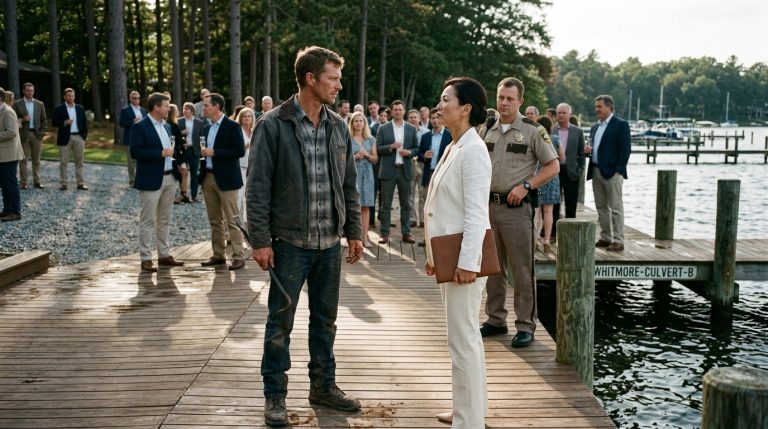
Dr. Thorne walked straight past her, his jaw set in a hard, grim line, and stopped beside Jack. “Ms. Bishop,” he said coldly. “I am Dr. Aris Thorne from the state university. This is Ms. Albright from the state attorney general’s office, historic preservation division. And you are standing in violation of a state-issued injunction.”
As if responding to a cue, a third vehicle turned into the drive—a dusty blue pickup truck carrying two men dressed in practical work clothes and heavy boots. The older man stepped down first, his face carved from deep lines of heritage and quiet dignity, his dark eyes fixing on Karen with an expression of profound, chilling weight. Joseph Blackfox, the tribal historic preservation officer, had arrived.
The yard filled with an oppressive, suffocating silence. Karen stood trapped in the center of the gravel drive, surrounded on all sides by the quiet machinery of the law, completely unaware of the abyss opening beneath her feet.
CHAPTER 8: THE AFTERMATH AND THE FINAL RETREAT
The morning air felt thin and dry against Jack’s face as the deputy took another slow step forward, his hand resting casually near the grip of his holster. The landscaping truck idled quietly behind the cruiser, its exhaust puffing thin, gray rings into the stagnant air.
Karen stood frozen in the center of the gravel drive, her mouth opening and closing in short, jerky movements like a fish pulled dry onto a dock. The absolute certainty that had fueled her weeks of harassment—the manufactured violation notices, the high-priced letters from Wilhelm Stone and Associates, the emergency board meetings—had collided with an immovable wall of physical reality.
“Ma’am,” the deputy said, his voice dropping an octave into a tone that brooked no argument. “Violation of the Native American Graves Protection and Repatriation Act is a federal felony. Willful destruction of a state-registered archaeological site carries severe prison time and compounding financial penalties. You were about to order these workers to commit a federal crime on your behalf. Do you understand the scope of what is written on this paper?”
He gestured toward Ms. Albright, who held the state-sealed injunction steady in her hands, her expression as cold and unyielding as a slab of granite.
Karen’s face cycled through a rapid spectrum of pale terror and desperate denial. She looked toward Dr. Thorne, then toward Joseph Blackfox, whose dark, deep-set eyes remained fixed on her with an unblinking, ancestral weight. Finally, her gaze fell upon Jack.
“I didn’t know,” she whimpered, her voice cracking, the polished veneer of suburban royalty completely stripped away. “It’s just a grass patch. It’s just a scarecrow. How was I supposed to know?”
“You didn’t know because you never bothered to ask,” Jack said quietly. He walked forward until he stood just paces away from her, his presence casting a heavy shadow across the hood of her golf cart. “You saw land you didn’t control and a man who wouldn’t bow to your schedule, and you decided to break him. You never once looked at the history beneath your feet, or the meaning behind it. You were too busy building an empire out of plastic siding and HOA fees.”
Jack pulled his phone from his pocket, tapping the screen once to bring up the audio file of the closed-door board meeting. He didn’t play it; he simply held it up where she could see the glowing waveform of her own voice frozen on the display. “I have the entire record of your conspiracy. The board members you threatened, the illegal vote, the explicit instructions to trespass. The state attorney general’s office has a copy. The county prosecutor has a copy.”
Ms. Albright stepped forward, sliding a crisp, official citation out of her leather portfolio and handing it directly to Karen’s trembling fingers. “This is your temporary stop order and formal notice of criminal investigation, Ms. Bishop. You are legally restricted from leaving the county pending the formal grand jury review of the Creekwood Estates HOA leadership.”
The deputy finished the sequence by issuing a standard misdemeanor citation for criminal trespass. It was a modest piece of paper compared to the federal felonies hanging over her head, but it was the first official fracture in her pristine record—a public, legal brand marking the exact boundary where her petty tyranny met its end.
Defeated, crushed under the overwhelming weight of law, history, and evidence, Karen turned mechanically toward her golf cart. The high-powered electric vehicle no longer looked like a royal chariot; it looked like a child’s toy, ridiculous and pathetic against the backdrop of the rugged 5-acre farm. She climbed into the driver’s seat, pulled hard on the steering wheel, and crept away down the gravel path, her retreat silent save for the crunch of tires grinding into the dust she had so carelessly torn up days before.
The landscaping workers didn’t wait. With a quick nod to the deputy, they threw their equipment back into the truck bed, slammed the tailgate, and backed out of the drive, disappearing down the county road.
Slowly, the tension bled out of the morning air. Ms. Albright and the deputy climbed back into their cruisers and departed, leaving the lane quiet once more. Dr. Thorne and his graduate student packed their GPR equipment into the university truck with quiet, respectful care, exchanging a firm handshake with Jack before rolling out to file their permanent site documentation with the state archive.
Only Joseph Blackfox remained. The tribal preservation officer walked slowly out toward the back field, stopping at the base of the wooden cross where Silas stood his silent watch. Jack walked with him, the two men standing side by side in the quiet stillness of the earth.
“She thought she owned the view,” Blackfox said softly, his voice like dry leaves brushing across stone. “She forgot that the land remembers who walked it first.”
“She won’t bother this place again,” Jack replied, his gaze fixed on the lopsided, stitched-on smile of the scarecrow.
After the tribal officer departed, the farm settled into a profound, healing quiet. The sun climbed toward its zenith, warming the weathered gray boards of the farmhouse porch. Jack walked out to the tractor lane where the deep, ugly gashes had been carved into the turf by Karen’s golf cart weeks ago.
He didn’t leave them scarred. Working with deliberate, methodical care, he fetched a wheelbarrow filled with rich topsoil from the compost heap, shovaled the dark earth into the tire ruts, and tamped it down firmly with the flat head of his shovel. He raked the surface smooth, scattered a handful of hearty fescue seed across the patch, and watered it down with a steady, gentle stream from the hose.
When the ground was mended, he walked back to the kitchen porch and picked up the small wooden stool he had left by the door. He sat down facing the back field, the smell of damp earth and blooming tomatoes hanging thick in the warm afternoon air.
Silas stood tall against the horizon, his burlap head catching the afternoon breeze, steadfast and unmoving. Jack reached out, resting his hand against the worn wooden railing of the porch, feeling the solid, unyielding grain beneath his fingers. The war was over. The boundaries were secure. And the quiet places of the earth remained safe.