The Echo of the Shadow: A Veteran’s Journey from Erasure to the Light of Brotherhood
CHAPTER 1: The Weight of Silence
The San Diego Veterans Affairs Hospital smelled of antiseptic and forgotten dreams. It was a scent Admiral Michael Hastings knew well—the sharp, chemical edge of clinical efficiency fighting against the slow, steady decay of time. He moved through the hallway with the practiced stride of a man who commanded more than just his own schedule. His uniform was crisp, his presence an anchored point in the chaotic ebb and flow of the ward.
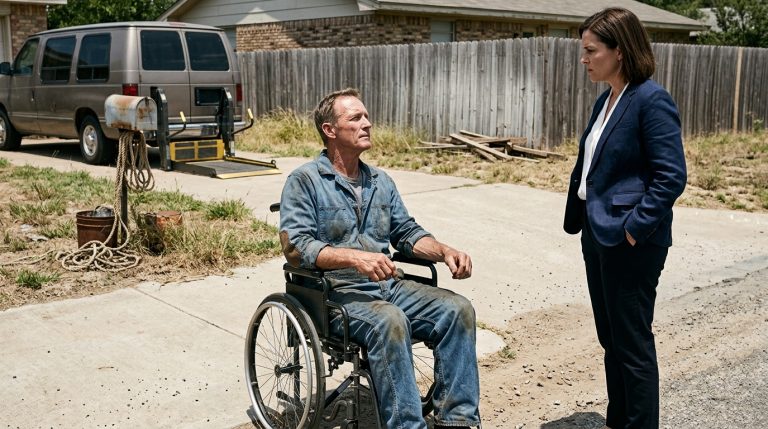
He stopped, as he always did, by the sun-drenched window near the North Wing. There, a man sat in a wheelchair, his posture a testament to a long-buried stiffness. He was frail, his skin mapped with the deep-set lines of a man who had weathered seasons in places where the sun didn’t reach. His right pant leg was pinned and folded, a neat, tragic triangle of fabric that caught the late-morning light.
“Good morning,” Hastings said, his voice dropping into the respectful cadence he used for the men who had paved the road he walked on. He held out a hand, a gesture of simple, human solidarity. “Thank you for your service.”
The old man looked up. His eyes were the color of slate under a winter sky—faded, distant, but unnervingly sharp. He didn’t reach for the Admiral’s hand. Instead, his thin fingers drummed a rhythmic, nervous cadence against the metal armrest. The metal groaned slightly under the pressure.
“Routine, isn’t it?” the man said. His voice wasn’t the creak of age; it was a rough, dry rasp, like sandpaper on stone. “You stop, you thank, you walk. It’s a clean cycle, Admiral.”
Hastings smiled faintly, but the hair on his arms pricked up. He was used to the cadence of veteran conversations, but this felt different. There was a precision to the man’s observation that didn’t fit the clinical drift of a long-term patient. Out of habit—the polite, PR-driven reflex—Hastings tipped his head. “I try to make the rounds. It’s the least I can do. May I ask your call sign, sir?”
The old man paused. The hospital corridor seemed to tilt on its axis. He didn’t blink. “Shadow One.”
The name landed in the space between them not like a word, but like a physical blow. Hastings felt his breath catch in his throat, a sudden, sharp intake of air that burned. He had heard the legend in the hushed tones of the Buds training centers, a story used to test the mettle of candidates, a myth about a man who walked alone through the impossible.
“I’m sorry,” Hastings said, his voice tightening, his professional mask slipping just enough to reveal the man beneath. “What did you say?”
The old man leaned forward, his gray eyes piercing through the Admiral’s defenses. “Shadow One. It’s been a long time since anyone asked. And longer since anyone had the right to hear it.”
Behind Hastings, the three SEALs who had been shadowing his tour stopped dead. Their formation broke; the silence that filled the hallway was thick, heavy, and suffocating. The old man didn’t look at them. He only looked at Hastings, his hands trembling—not from age, but from the sudden, overwhelming pressure of a secret finally finding an exit. And then, he reached into his breast pocket and pulled out a small, tarnished object that caught the fluorescent light, the surface etched with a symbol that sent a cold shiver down Hastings’ spine: a trident, crossed by a shadow.
CHAPTER 2: The Architecture of Ghosts
The consultation room was small, a cramped box of cinderblock and humming fluorescent light. It felt like a submarine compartment buried under the weight of the hospital’s sterile, unending routine. Admiral Michael Hastings remained frozen, his eyes locked on the coin. It was not a standard-issue token. It was heavier, the metal worn smooth by decades of anxious friction, the edges blunted as if it had been gripped through a thousand sleepless nights.
William Grant didn’t offer the coin. He held it, his thumb tracing the shadow-trident insignia, his gaze fixed on a point somewhere behind the Admiral’s shoulder. The room grew colder. Hastings felt the presence of the three SEALs behind him—Webb, Collins, and the other—shift, their heavy combat boots scuffing the linoleum. The sound was like a gunshot in the quiet.
“You recognize it,” Grant stated. It wasn’t a question. His voice was no longer the rasp of a patient; it carried the clipped, rhythmic cadence of a tactical briefing. “You recognize the mark of an operator who didn’t exist.”
Hastings carefully sat down. He kept his movements slow, deliberate, the way one might approach a wounded animal that still possessed teeth. “That design isn’t in any manual, William,” he said, using the man’s first name as a bridge. “But I’ve seen it. On the walls of the oldest briefing rooms in Coronado. A ghost story for the candidates.”
“It wasn’t a story to those of us in the wire,” Grant replied. He set the coin down on the small metal table between them. The sound of the metal hitting the table was sharp, unforgiving. “It was a contract.”
Hastings looked at the men behind him. Master Chief Webb, a man who had seen the worst of the modern conflicts, looked as though he were reading his own obituary. Hastings turned back to Grant, his mind racing through the logic of the impossible. If this man was real, then the foundational history of the SEAL teams was built on a foundation of calculated, systematic erasure.
“Why now?” Hastings asked. He kept his voice low, a tactical whisper intended to contain the truth within the four walls of the room. “After fifty years of silence, why pull that coin out now?”
Grant looked at the flickering overhead light. A sudden, sharp sound—the rhythmic clicking of a cooling fan—snapped through the room. For a heartbeat, Grant’s eyes widened, his head tilting toward the ceiling as if hearing a high-frequency radio burst through the static of a thick, suffocating jungle canopy. The phantom memory of it washed over him, a cold sweat breaking across his brow. He wasn’t in a San Diego hospital anymore; he was huddled in the mud, waiting for a signal that never came, the humidity of Vietnam clinging to his skin like a shroud.
“The silence is rotting,” Grant whispered, his eyes focusing back on the Admiral with a frightening intensity. “I spent my life believing the Navy scrubbed me to protect the team. I told myself it was an administrative necessity—a file misplaced in the chaos of 1975, a standard, bureaucratic disaster that turned me into a non-person. I’ve lived with that lie so I could sleep.”
“And that’s not the truth?” Hastings asked, his own heart hammering against his ribs.
Grant let out a dry, mirthless laugh. “A file doesn’t just disappear, Admiral. People disappear files. If it were just an oversight, I would have been reinstated by 1980. But I was moved, shuffled, and threatened. They didn’t lose me. They quarantined me.”
Hastings felt the weight of the room press in. The decoy theory—the convenient belief that this was merely the result of a mid-seventies administrative collapse—was disintegrating before his eyes. It was too clean, too organized to be an accident. He leaned in, ignoring the protocol of his office. “Who?”
“Does it matter?” Grant asked, looking toward the window where the sunlight hit the dust motes dancing in the air—faded, golden, and utterly indifferent to the history he held in his hand. “The people who ordered it are ghosts now, just like me. But the precedent… the precedent is still there. If I am real, then the mission was real. And if the mission was real, then the cost of what you people do—what you are—is something you have to be prepared to own.”
Master Chief Webb stepped forward, his shadow falling over the table. “Chief, if there is a trail, we can find it. We have the archives. We have the access.”
Grant looked at Webb, his expression softening just a fraction, a momentary crack in the armor of his long, guarded life. “You want to dig? You want to look into the dark?”
“Yes,” Hastings said firmly. “Because if you were a ghost, William, you’re the only one who can tell us what actually happened to the ones who didn’t come back. For them, we need to know.”
Grant picked up the coin, pressing it into Hastings’ palm. The metal was cold, biting into the skin. “Then be careful, Admiral. When you pull on the thread of a ghost, you don’t just find the truth. You find the things that were supposed to stay buried.”
The air in the room felt heavy, charged with the static of an impending storm. Hastings stood up, the coin tucked securely in his pocket, a burning anchor of reality in a world of institutional ghosts. He knew, as he turned toward the door, that he wasn’t just walking out of a hospital; he was walking into a narrative that threatened to rewrite the very history he had spent his life defending. He motioned for his men to follow, but as he reached for the door handle, he paused. A strange, inexplicable sense of observation prickled at his neck—the feeling of being watched by eyes that weren’t in the room, but were somehow connected to the very walls around them.
CHAPTER 3: The Archive Chase
The hallway outside the consultation room was a long, narrowing throat of clinical white tiles and flickering yellow light. Admiral Michael Hastings didn’t look back, though the urge to see William Grant one last time was a physical ache in his chest. He maintained a steady, measured pace, his SEALs—Webb, Collins, and Miller—moving in practiced synchronization behind him. They didn’t speak. The silence was absolute, save for the rhythmic, dull thud of tactical boots against the linoleum.
“Admiral,” Webb said, his voice a low-frequency rumble that barely carried above the sound of the hospital’s ventilation system. “That door. Did you notice the mechanism?”
Hastings stopped, his hand still resting near the pocket where the coin resided. He turned his head just enough to catch Webb’s eyes. “I noticed it, Master Chief.”
The lock had engaged with a sound that didn’t belong in a public VA facility. It was a digital, high-security snick, the kind that whispered of magnetic overrides and remote surveillance. Someone, somewhere, was listening to the echo of the Shadow One’s return.
“We aren’t alone in this building,” Hastings said, his tone devoid of surprise. It was a tactical assessment, cold and necessary. “The moment that call sign was spoken, we triggered a sensor. They’ve been waiting for this name to surface for fifty years.”
“If they’re watching, they know we have the coin,” Collins whispered, his hand drifting toward his hip.
“Let them watch,” Hastings replied, his gaze scanning the corridor. “If they wanted us gone, the lights would have gone out already. They’re scared. That means we have the advantage.”
They reached the service elevator—a slow, shuddering cage of rusted steel and mesh that smelled of damp concrete and ozone. Hastings punched the button for the lower levels, the service bays where the facility’s historical archives were kept. It was a labyrinth of forgotten files and paper records, a place where, historically, the Navy had buried its most inconvenient truths.
The descent was agonizingly slow. The elevator groaned, the cable shuddering against the pulleys, and for a moment, the car stalled between floors. In the sudden, oppressive silence, Hastings felt the texture of the building shift. The sterile, polished surfaces of the upper floors gave way to the rough, unfinished reality of the base structure—the rusted iron, the peeling paint, the raw grit of a facility that had been built for a war that was supposed to have ended decades ago.
He pulled the coin from his pocket and held it up to the dim light. The trident symbol seemed to pulse, its edges sharp against his calloused skin. He thought of Grant, the old man’s eyes holding the reflection of a jungle he could never leave behind. ‘Don’t just find the truth,’ Grant had warned. ‘Find the things that were supposed to stay buried.’
The elevator jolted, then dropped another six inches before catching. Hastings gripped the railing, his knuckles whitening. “Webb, when we hit the basement, I want the secure line to the Coronado archives open. I want the compartmented files. If they’ve scrubbed the records, there’s a footprint. A ghost doesn’t just walk through history without leaving a shadow.”
“The archivist I mentioned,” Webb said, his brow furrowed in deep concentration. “She’s an old guard. She knows the deep files. But Admiral, if we access those records, it’s going to ping every monitoring station in the Department of the Navy. There’s no going back.”
“I’m not looking to go back,” Hastings said, watching the floor indicator slowly descend.
The lift hit the basement level with a final, jarring thud. The doors slid open to reveal a corridor drenched in shadow, the floor slick with a thin film of moisture. It was a graveyard of information, rows upon rows of filing cabinets that looked like sentinels standing guard over a dark, forgotten history. The smell was the scent of rot and ink—the organic decay of paper fighting against the metallic tang of an underground vault.
Hastings stepped out into the damp air. His feet hit the concrete with a hollow, echoing ring. He knew this floor. It was where the records of the 1968-1975 deployment were meant to be stored, the forgotten years of the Vietnam transition.
“Start with the Special Access logs from ’75,” Hastings ordered, his voice echoing off the concrete walls. “If Grant was a sacrifice for the sake of the mission, then someone signed the order to erase him. I want that signature.”
He walked down the center aisle, his fingers tracing the rusted surfaces of the filing cabinets. The metal was cold, biting, and covered in a fine layer of dust that hadn’t been disturbed in decades. He wasn’t just searching for a document; he was searching for the exact moment when the Navy’s moral compass had been intentionally inverted. Every step felt like a breach, a violation of a silent, unspoken pact between the institution and the men who had bled for it. And beneath the sound of his own breathing, he could have sworn he heard the faint, rhythmic clicking of a radio signal, ghosting through the dust and the dark.
CHAPTER 4: The Ghost in the Machine
The air in the basement archives was heavy, tasting of ozone and dust—a stagnant, suffocating atmosphere that seemed to swallow the light. Admiral Michael Hastings stood before a bank of steel filing cabinets, their surfaces scarred by rust and neglect. The drawers were stiff, protesting with a long, metallic screech as he pulled the one labeled ‘1975 – Special Access – Vietnam Operations.’
Master Chief Webb stepped in close, his tactical light cutting a harsh, white cone through the gloom. “I’ve got the primary digital logs open on the terminal, Admiral,” he said, his voice unusually strained. “But the server is… it’s clean. Too clean. Even the entry logs have been overwritten.”
Hastings ignored the screen, his focus entirely on the physical reality of the paper before him. He riffed through the folders, his fingers moving with surgical precision. Each one was a testament to the meticulous, soul-crushing bureaucracy of the era. Purchase orders for boot polish, flight manifest logs for logistics runs, routine debriefs from standard patrol units. It was the white noise of a war machine.
Then, he stopped.
There was a physical discrepancy. Between the entries for early April 1975 and the final evacuation protocols, there was a gap. A folder had been removed. More than that, the metal guide tab was bent, the edges of the surrounding files frayed and pressed in as if someone had wrenched a thick ledger from its place in a frantic, unpracticed hurry.
Hastings reached into the gap, his calloused fingertips feeling the rough, unvarnished edge of the steel shelf. He pulled his hand back, revealing a smudge of fine, dark grease on his skin. It wasn’t dust. It was lubricant—gun oil, old and dried.
“Webb,” Hastings said, his voice dropping to a low, dangerous vibration. “Look at this.”
Webb leaned in, the beam of his light settling on the gap. The Master Chief whistled softly. “Someone didn’t just file this away. Someone ripped it out.”
“Administrative oversight,” Hastings muttered, his eyes narrowing as he surveyed the rows of cabinets. “That’s what the records say about Grant. That he was just lost in the shuffle.” He gestured to the bent steel. “This wasn’t a shuffle. This was an extraction.”
He moved to the next drawer, his pulse quickening. If the records were scrubbed to hide a political embarrassment, there had to be a redundant copy, or at least a sign of the authorization that ordered the deletion. He wasn’t looking for a war story anymore; he was looking for the authority that had deemed a man’s existence a liability.
As he worked, a low, rhythmic sound began to resonate through the basement—a steady, pulsing thrum of the building’s infrastructure. It sounded too much like the machinery Grant had described in the hospital. Hastings froze, his hand hovering over a rusted lock.
“Admiral,” Miller, the youngest of the team, spoke from the perimeter of the room. “The service elevator. It’s moving. It’s coming back down.”
Hastings didn’t move. He kept his eyes locked on the dark throat of the hallway leading to the lift. He felt the weight of the coin in his pocket—a burning, solid reality in a room filled with lies. Whoever was coming down here wasn’t here to archive anything. The archive was a graveyard, and someone was coming to ensure that the ghosts stayed buried.
“Webb, how long to extract the logs on that terminal?” Hastings demanded, his voice sharp.
“Two minutes, maybe three. The encryption is legacy, but it’s dense.”
“You have one,” Hastings said. He turned to face the elevator, his posture shifting into a defensive, grounded stance. He checked his sidearm, the movement fluid and instinctual, though he prayed it wouldn’t come to that. He wasn’t just defending a file; he was defending the integrity of a man who had been erased by the very system he had served.
The elevator car began its mechanical whine, drawing closer. The shadows in the hallway seemed to lengthen, the flickering light casting elongated, distorted shapes against the walls of cabinets. Hastings realized then that the decoy—the idea that the files were just lost—was the perfect cover. It allowed the Navy to maintain its dignity while the truth rotted in the basement. But tonight, the decay would be interrupted.
As the elevator doors began to slide open with a long, drawn-out groan of metal on metal, Hastings didn’t retreat. He stood his ground, the cold, rusted surface of the filing cabinet behind him feeling like the spine of a shield. The truth was in the gap, and he was ready to pry it open, no matter what—or who—emerged from the dark.
CHAPTER 5: The Resonance of Truth
The elevator doors retracted to reveal a man in his late sixties, dressed in the sterile, nondescript tan jumpsuit of a maintenance technician. He didn’t look like an operator, but the way he held his ground, his center of gravity perfectly aligned, gave him away. He held a thin, yellowing folder with the same reverence a priest might accord a relic.
Admiral Michael Hastings stayed perfectly still, his hand resting near his sidearm. The silence in the basement vault deepened, the air thick with the smell of wet concrete and ozone.
“You shouldn’t be down here, Admiral,” the man said. His voice was a calm, modulated tenor that felt entirely out of place in the subterranean tomb of forgotten records. “This level was decommissioned in 1978. It’s not on the current floor plan.”
“And yet, here we are,” Hastings replied, his tone steady, clinical. “I’m looking for a file that isn’t supposed to exist. I think you have it.”
The man looked at the folder, then back at Hastings. He didn’t move toward him, and he didn’t move to flee. He simply waited, his eyes scanning Hastings and the three SEALs behind him with a cold, analytical precision. “You’re looking for the Shadow One extraction order. It doesn’t exist, sir. It was purged. That’s the official record.”
“Official records are curated,” Hastings said, stepping forward. The rust-covered floor crunched beneath his boots. “I’m interested in the uncurated reality.”
Master Chief Webb stepped to the side, his tactical light tracking the technician’s movements, but the man didn’t flinch. He walked forward, his footsteps silent, and extended the folder toward Hastings. It was an invitation, or perhaps a warning.
As Hastings took the folder, the dry, brittle sound of the paper rubbing against his skin was amplified by the vast, hollow chamber. He opened it. The pages were thin, onionskin paper that felt like dried leaves, covered in carbon-copied ink that had faded to a ghostly, sepia tone. It was a summary, not an order—an after-action report for Operation Silent Shadow, dated May 12, 1975.
It detailed the extraction of two POWs from North Vietnam. It mentioned the loss of one operator’s leg. It ended with a single, typewritten note at the bottom, signed by a name Hastings had only ever seen in high-level classified histories of the Vietnam era—a man who had been a rising star in the Pentagon during the fallout of the war.
Recommendation: Terminate all documentation regarding Subject: Shadow One. Maintain status: KIA (Unrecovered). Reason: Diplomatic stabilization requirements override individual service recognition.
Hastings felt a surge of nausea. The ‘administrative oversight’ was a fiction—a comfortable lie designed to protect the reputation of the institution at the cost of one man’s humanity. He looked at the technician, whose face remained a mask of practiced indifference.
“Who are you?” Hastings asked.
“A ghost, much like the man you visited upstairs,” the technician said. “I was the junior clerk who filed this summary. I was told if I ever spoke of it, my own service record would be rewritten, too. I’ve been guarding this file for forty years, waiting for someone to actually come looking for the truth, rather than just burying it deeper.”
“Why now?”
“Because the man upstairs is dying, Admiral. And because the people who ordered this have all finally gone to their graves. The threat is gone, but the injustice remains.”
Hastings closed the folder. The weight of it in his hands felt like a moral precipice. He realized then that the archive wasn’t just a storage facility—it was a psychological trap. The institution had built this place to keep people like him from asking the wrong questions, hoping that the sheer, crushing volume of useless paper would eventually break the resolve of anyone who dared to dig.
“Webb, make sure this is digitized and uploaded to the secure server at Coronado,” Hastings ordered, his voice steadying. “Then, I want the original to be handled with chain-of-custody protocols until it can be placed in the memorial.”
“It’s not just a file, Admiral,” the technician added, his voice finally losing its modulation, a flicker of raw exhaustion breaking through. “Look at the witness testimony on page four.”
Hastings reopened the folder. He flipped to the fourth page, where a hand-drawn map of the camp was attached with a rusted paperclip. There was a notation in the margin, written in blue ink that had blurred over time. It was a name. Not the name of a commander, but the name of a liaison—the man who had personally overseen the scrubbing of Grant’s identity.
The name sent a jolt of recognition through Hastings. It wasn’t a stranger. It was a name that still held sway in current naval circles, a name that was currently attached to a scholarship program for young SEAL candidates.
The realization hit him with the force of a physical blow. The erasure of William Grant wasn’t just a cold-war relic—it was a legacy. The system hadn’t just protected the past; it had been actively laundering the reputation of the men who had betrayed the very code that defined them. The deeper he dug, the less it felt like a history lesson and the more it felt like he was walking into a mirror, seeing the cracks in the foundation of everything he had fought to uphold. He looked back at his men, then at the technician, and finally at the folder. He wasn’t just bringing a man home; he was preparing to dismantle the myth of the system itself.
CHAPTER 6: The Unveiling
The basement vault groaned, the sound of failing relays echoing through the concrete chamber like the dying breaths of a wounded beast. A sudden, sharp electrical pop sent a spray of sparks across the aisle of filing cabinets, followed by the dying flicker of the fluorescent lights. Then, a heavy, rhythmic thrum—the backup generators fighting for purchase—and the entire room was bathed in the harsh, disorienting glare of emergency red lighting.
Admiral Michael Hastings didn’t flinch. He didn’t even drop his gaze from the folder. The red light washed over the technician’s face, turning the man’s features into a sharp-angled mask of shadows.
“That wasn’t a power failure,” the technician said, his voice unusually strained, the calm modulation finally shattering. “That’s a system purge. The server is scrubbing the local drive. We have seconds before the network link is severed.”
“Webb, status!” Hastings barked, his voice cutting through the hum of the failing infrastructure.
“I’m losing the connection, Admiral!” Master Chief Webb’s face was reflected in the glow of the terminal, his fingers dancing across the keys with frantic, desperate energy. “Something is intercepting the data packets. It’s a remote override. Someone at Coronado is watching this in real-time.”
Hastings slammed the folder shut, his grip tightening until his knuckles burned. The name in the margin—Patterson’s father’s superior, the man whose scholarship fund graced the faces of every young SEAL trainee—wasn’t just a name. It was the keystone of the entire institutional deception. By building the memorial, by establishing the scholarship, this man had successfully laundered his own history, turning a cold-blooded bureaucratic sacrifice into a legacy of honor.
“We have what we need,” Hastings said, his voice cold, stripped of any lingering uncertainty. “Miller, secure the technician. Webb, pull the drive manually. If we can’t send it, we carry it.”
“Admiral, the doors!” Collins shouted from the perimeter.
The heavy, steel-reinforced security door at the far end of the vault had begun to cycle shut, the hydraulic mechanism hissing with lethal intent. It wasn’t an accident. The system had identified the breach and was attempting to contain it—not just by scrubbing the data, but by sealing the vault entirely.
Hastings didn’t hesitate. “Move! Now!”
They sprinted toward the narrowing gap, their tactical gear clattering against the concrete. The smell of burning plastic from the overheating servers grew thick, a cloying, chemical scent that clawed at the back of his throat. He saw the technician move, not to flee, but to jam a heavy, rusted metal chair into the tracks of the sliding door.
The mechanism shrieked, the motor straining, the metal of the chair bending under the immense hydraulic pressure. The door stuttered, a ten-inch gap remaining, a sliver of darkness leading back into the labyrinthine service tunnels of the hospital.
“Go!” the technician yelled, his face tight with the physical exertion of holding the door. “The tunnels lead to the maintenance egress on the north side. Get that file out of here!”
Hastings shoved Miller and Collins through the gap, then grabbed Webb by the tactical vest and hauled him through, the hard steel frame of the door scraping against his shoulder. He scrambled through the opening, the cold air of the service tunnels hitting him with a sudden, sharp relief. He turned back, reaching for the technician, but the man shook his head, his hands still locked onto the chair, his feet braced against the floor.
“I’m the only one they’ll look for,” the technician said, his eyes meeting Hastings one last time. “Go. The truth is in your hand, Admiral. Don’t let it stay there. Build the memorial.”
The hydraulic motor surged, a high-pitched, whining scream of metal, and the door slammed shut with the finality of a guillotine. The chair snapped, the sound like a brittle bone breaking. Hastings stood in the damp, claustrophobic silence of the service tunnel, the red emergency lighting from the other side of the door cut off.
He was in the dark. He had the file, he had the evidence of a systematic betrayal, and he had the name of the man who had ordered it. But as he stood there, listening to the muffled, heavy thud of boots echoing from the upper levels of the hospital, he realized the scope of the battle ahead. This wasn’t just a fight for a man’s legacy; it was a fight against an institution that had mastered the art of erasing its own sins. He tucked the folder into his tactical vest, right against his chest, the edges biting into his ribs, and turned toward the north egress, his pace quickening, his resolve hardening into something far colder and more dangerous than it had been when he first walked into the hospital.
CHAPTER 7: The Weight of the Current
The North maintenance egress was not a corridor; it was a throat of raw, sweating concrete that plunged downward into the belly of the facility. Admiral Michael Hastings hit the landing, his momentum nearly carrying him into the dark, when the floor groaned—a deep, tectonic shift—and the entire section of the service tunnel buckled.
A torrent of stagnant, oil-slicked water erupted from a burst pipe, hitting the narrow space with the force of a tidal wave. The sound was deafening, a roar that obliterated any possibility of stealth. Hastings, his lungs already burning from the stagnant air of the basement, felt his boots lose traction on the slick incline. He slammed into the wall, the rough, jagged concrete biting into his shoulder, and felt the water rushing past his ankles, rising toward his knees with terrifying speed.
“Stay together!” Hastings roared, his voice barely audible over the chaotic gush of the deluge.
Webb, Miller, and Collins were shadows in the dim, flickering red emergency lighting that managed to bleed into the shaft from a distant, broken junction box. They were moving, but the environment was actively fighting them. The water was rising, thick with sludge and the detritus of fifty years of neglect. Every step forward was a battle against the viscous, pulling force of the current.
Hastings felt the file in his vest, its edges digging into his ribs, a wet, heavy weight that reminded him why they were here. He surged forward, pushing off the wall, his hands reaching for the ladder rungs bolted into the damp concrete. The metal was cold, slick with grime, and vibrating with the pressure of the subterranean flood.
“The egress is blocked!” Collins shouted from ahead, his voice rising in panic as he reached the end of the line. “The drain gate is rusted shut!”
Hastings pulled himself up, his eyes straining to see through the murk. The water was at their waists now, the pressure of it pushing them against the ladder. He saw the gate—a heavy, iron grid that hadn’t been moved since the seventies. It was corroded into the frame, a solid, immovable barrier of oxidized steel.
“Webb, I need that pry bar from your kit!” Hastings yelled. He didn’t wait for a reply, reaching into the Master Chief’s gear as he pulled alongside him. The metal of the tool felt like ice in his hands, a stark, grounding contrast to the chaos of the rising flood.
He jammed the bar into the seam of the gate, his muscles screaming as he applied leverage. The metal groaned—a high, piercing sound of friction that set his teeth on edge. It didn’t budge. He could feel the water continuing to climb, now pressing against his chest, the weight of it threatening to pin him to the ladder.
This was the institutional weight made manifest. It wasn’t just a gate; it was the physical resistance of every decision, every secret, every silent compliance that had kept the truth of Shadow One buried for half a century.
“Together, on three!” Hastings commanded.
He locked his boots into the rungs, his hands white-knuckled on the bar. Webb and Miller joined him, their combined weight pushing against the cold, dead iron. They were a single, straining unit, their breath ragged and sharp in the damp air.
“One! Two! Three!”
They shoved. The gate screamed, a sound that finally shattered the silence of the facility. With a violent, grinding shiver, the rusted metal sheared away from the frame. The gate swung outward, the sudden release sending them all tumbling into the darkness beyond.
They hit the shallow pool of the storm-drain overflow on the other side, the water here calmer, colder, and smelling of the open air. Hastings came up sputtering, his hands immediately checking his chest, ensuring the folder was still protected inside his vest. It was still there—wet, heavy, and holding the only truth that mattered.
He stood, wiping the grime from his eyes, and looked back at the breached gate. The red emergency light from the vault tunnel flickered one last time, casting long, distorted shadows against the archway. He could hear voices now—muffled, sharp commands emanating from the other side, the sound of security teams rushing the vault.
He looked at his men. They were soaked, shivering, and covered in the dark sludge of the facility’s underbelly, but they were breathing. He signaled for them to move, his eyes locked on the faint, distant shimmer of moonlight filtering through a street-level grate at the end of the tunnel. They had the evidence, they had the name, and they had survived the first attempt to erase them. But as he turned to lead them toward the surface, he felt the heavy burden of the secret pressing into his side—a truth that wasn’t just a file, but a living, breathing accusation against the very people who were currently closing in behind them.
CHAPTER 8: The Price of the Light
The city air tasted of diesel and salt—a sharp, aggressive departure from the stagnant rot of the archives. Admiral Michael Hastings pushed his head through the heavy iron grate, his hands scraping against the rough stone of the alleyway foundation. He hauled himself out, the mud of the maintenance tunnels coating his uniform in a dark, abrasive film. Webb, Miller, and Collins followed in quick succession, their movements ragged, the exhaustion of the night finally catching up with them in the cold, clear air.
They were in an industrial sector of San Diego, a cluster of warehouses and dormant loading docks that sat in the shadow of the Naval base. The city lights flickered in the distance, a sprawling, indifferent grid that seemed oblivious to the fact that, fifty feet below, the foundation of a fifty-year-old lie had just been cracked open.
“We have to get to Coronado,” Webb said, his breath hitching as he checked his sidearm. “If we go to the main gate, they’ll have the internal security teams waiting. The order to purge the records didn’t just come from the basement; it came from the top.”
Hastings nodded, his fingers instinctively brushing the breast pocket of his vest. The file was there—a dense, heavy lump of paper that felt more substantial than his own heart. “We don’t go to the gate. We go to the secure boat launch on the harbor side. I have a contact in the harbor patrol who doesn’t report through the standard chain.”
As they moved through the labyrinth of shipping containers, the weight of the night began to settle in. Hastings thought of the folder, of the name in the margin—Admiral Arthur Sterling, the man who had authored the “diplomatic stabilization” memo, the same man whose legacy was now plastered on the scholarship banners in every training facility in the fleet. Sterling hadn’t just buried a man; he had built a monument over his grave and called it honor.
“Admiral,” Miller whispered, his hand stopping Hastings’ arm. “Look.”
At the end of the alley, a black sedan sat idling under a flickering street lamp. It wasn’t a military vehicle, but it sat with the predatory stillness of one. The driver’s side window rolled down, and the faint, rhythmic glow of a cigarette ember pulsed in the dark.
“They aren’t trying to capture us,” Hastings realized, his eyes narrowing as he scanned the perimeter. “They’re waiting for us to make the choice.”
If they took the file to the base, they were declaring war—not just on a corrupt officer, but on the institution that Sterling had spent decades insulating. If they walked away, they remained ghosts, just like Grant.
“If we move,” Hastings said, his voice a low, steady rumble, “we don’t stop. Miller, take the flank. Webb, follow the perimeter. We aren’t going to negotiate.”
They surged forward, the sudden, sharp friction of their boots against the asphalt drawing the sedan’s attention. The engine roared to life, but before the driver could engage, Hastings fired a single, calculated shot into the sedan’s rear tire. The car lurched, the rubber shredding with a violent, snapping sound.
“Go!” Hastings shouted, his focus narrowing to the shimmering water of the harbor just ahead.
They didn’t look back as they cleared the alley and vaulted the seawall, their bodies hitting the dark, cold water with a splash that felt like a baptism. The bay was quiet, the rhythmic lap of waves against the pylons masking their movement. They swam toward the harbor patrol slip, their bodies moving in the perfect, silent unison of the teams.
Hastings felt the file inside his vest. The water was soaking through, the paper softening, but he kept his arm pressed tight against his chest, a desperate, protective instinct. He wasn’t just swimming toward a boat; he was swimming toward a confrontation that would tear the uniform he wore apart. The truth was no longer something he held; it was something he had become. And as he pulled himself onto the slick metal of the patrol launch, he knew that by the time the sun rose over Coronado, the legend of Shadow One would be the least of the Navy’s problems.
CHAPTER 9: The Harbor of Reckoning
The harbor patrol boat was a blunt instrument—a utilitarian vessel of grey steel and salt-crusted glass. It didn’t possess the sleek agility of a SEAL craft, but it had weight, cutting through the chop of the San Diego Bay with a relentless, shuddering momentum. Admiral Michael Hastings stood at the helm, his knuckles white as he gripped the wheel. Behind him, Webb, Miller, and Collins were huddled in the small cabin, their gear shedding puddles of oily, subterranean water onto the deck.
The skyline of Coronado loomed ahead, a jagged, dark silhouette against the pre-dawn sky. To anyone else, it was home—the seat of their training, their history, their pride. To Hastings, it looked like a fortress that had been built on a foundation of sand.
“We’re two minutes out from the private pier, Admiral,” Webb said, emerging from the cabin. He looked gaunt, his face a map of the adrenaline crash that was beginning to set in. “I’ve checked the frequency logs. They’re locking down the base. Command knows we’re out here. They know we have the file.”
Hastings glanced at the dashboard. The radio was silent, but it was the silence of a held breath. The base’s radar net would have picked them up the moment they crossed the outer harbor line. They were walking—sailing—into a standoff.
“They won’t intercept us,” Hastings said, his voice hard, projecting more confidence than he felt. “Not here. Not where the eyes of the other units might be watching. They’ll wait until we’re on the pier. They’ll try to contain this as an internal matter, an administrative issue.”
“And if they try to take the file by force?” Collins asked, stepping out onto the deck, his hand resting on his sidearm.
“Then we don’t let them take it,” Hastings replied. He looked down at the folder tucked inside his vest. The water had compromised the outer edge, the ink on the margins bleeding into the pulp, but the signature of Arthur Sterling remained clearly legible—a damning, immutable mark of institutional betrayal.
The boat surged forward, the pier lights coming into focus. It was empty, a lonely finger of concrete poking into the black water. But Hastings could see them—shadows stationed at the edge of the perimeter. Not harbor security. Not standard duty officers. They were too still, too disciplined. They were internal security, the silent gatekeepers of the Navy’s most guarded reputations.
“They’re waiting,” Webb noted, his voice dropping to a whisper.
“Good,” Hastings said, slowing the engine. “I’m tired of looking for them.”
He eased the boat into the slip, the fenders groaning as they met the piling. The world felt unnervingly small, a claustrophobic cage of salt air and steel. He cut the engine, and the silence that rushed in was absolute.
As he stepped onto the pier, the cold wind whipped his damp uniform against his skin, a biting, abrasive sensation that focused his mind. The shadows stepped forward. One of them, a man in a crisp, unmarked duty suit, held up a hand.
“Admiral Hastings,” the man said. His voice was polite, rehearsed. “You are off-station. You are ordered to relinquish all materials recovered from the maintenance facility to security and report to the Commanding Officer’s office for an immediate debrief.”
Hastings stopped, ten feet from the line of guards. He felt the cold, hard weight of the folder against his heart. He looked past the guards, toward the administration building where Sterling’s legacy was housed—where the memorial, the scholarship, and the monuments to a manufactured honor resided.
“The material is not for security,” Hastings said, his voice carrying the calm, terrible weight of a final decision. “It’s for the record. And the record is going to be updated tonight.”
He reached into his vest, pulling the folder out. It was sodden, heavy, and stained with the sludge of the basement, but as he held it out, it caught the first grey, unforgiving light of the approaching dawn. The guards stiffened, their hands drifting toward their belts, but they hesitated—they weren’t prepared for the Admiral to walk straight into the center of the trap. Hastings watched them, his pulse steady, his mind clear, knowing that the next few seconds would determine if the truth survived the night or if he would be the latest name added to the list of ghosts.
CHAPTER 10: The Horizon Check
The pier was silent, save for the rhythmic, slap of bay water against the pilings. Admiral Michael Hastings didn’t look at the guards. He watched the horizon, where the first, thin line of amber light was beginning to pierce the darkness of the San Diego morning. The guards moved forward, a wall of dark suits and absolute, chilling obedience.
“Admiral,” the man in the lead repeated, his voice devoid of emotion. “The file. Now.”
Hastings turned. He looked at the man—really looked at him—and saw the hollow, practiced apathy of an instrument. He wasn’t fighting a man; he was fighting a machine. He held the folder out, the paper damp and yielding in his grip. As the guard reached for it, Hastings didn’t let go. He looked past the guard, toward the administration building, where he knew Arthur Sterling’s office was already lit.
“You want it?” Hastings asked, his voice steady. “Then you’ll have to take it. But understand this: when you take this file, you aren’t silencing a ghost. You’re confirming everything that Shadow One died to protect, and everything you’ve spent fifty years trying to bury.”
He let go. The guard grabbed the folder, his hands closing around the evidence of a decades-long betrayal. For a moment, the guard faltered, the sheer, crushing weight of the paper—and the weight of what it represented—seeming to surprise him.
“It’s too late,” Hastings said, his voice carrying clearly across the pier. “Before I walked onto this boat, I sent the digitized contents to every major news outlet, to the congressional oversight committee, and to the families of the men Grant rescued. You aren’t seizing a secret, Commander. You’re seizing a receipt.”
The guard froze. The color drained from his face as he realized the tactical reality of the situation. He looked down at the folder, then at the Admiral, and finally at the distant, silent windows of the command center. The machine had been outmaneuvered.
The payoff arrived in the form of a low, rhythmic thudding—not from the base, but from the water. A fleet of civilian news helicopters began to rise from the city side, their blades beating the air into a frantic, chaotic rhythm. They weren’t there for a PR event; they were there for the story.
Poetic justice arrived in the form of Sterling’s own hubris. The Commander, realizing the trap he had sprung was now his own prison, frantically reached for his radio. “We have a breach! Initiate containment on the administration building!”
Hastings stood still, watching the panic unfold. The guards weren’t looking at him anymore; they were looking at the sky, at the approaching lights, at the inevitable dissolution of the reality they had been hired to protect. The absolute truth of the 1975 sacrifice—the reality that they had traded a patriot’s soul for a temporary diplomatic peace—was no longer hidden. It was public record.
The cool down was slow, almost agonizing. Hastings turned away from the guard, walked past the confusion, and headed toward the water’s edge. He reached into his pocket and pulled out the tarnished challenge coin, the trident crossed by a shadow. He walked to the edge of the pier and knelt, his movements deliberate and quiet. He placed the coin into the water, watching it sink into the dark, churning depths of the bay.
He didn’t need the coin anymore. He had the memory, and he had the mission. He reached down and picked up a rusted, salt-worn mooring pin, a piece of industrial debris he had noticed earlier, and placed it firmly into his pocket—a symbol of the structural integrity he had helped to restore, the weight of the repair he had forced the institution to undertake.
He looked at his men. They were battered, exhausted, and standing tall against the rising light. He felt a deep, quiet connection to them—a brotherhood forged in the recognition of a shared burden.
The ordeal was over. The broader truth would play out in committee rooms and news cycles, but the immediate tactical conflict was finished. Hastings turned toward the base, not as a subordinate, but as a man who had done the work required of him. The air felt lighter, the silence of the morning no longer heavy, but expectant. He knew he had a long, difficult road ahead, but for the first time in his career, he knew exactly where he was going. He walked off the pier, his boots steady on the concrete, and began the long, deliberate journey toward the denouement of the lie he had just dismantled.