The Weight of the Blue Shirt: A Mentor’s Lesson in Humility and the Echo of Valor
CHAPTER 1: The Threshold of Humility
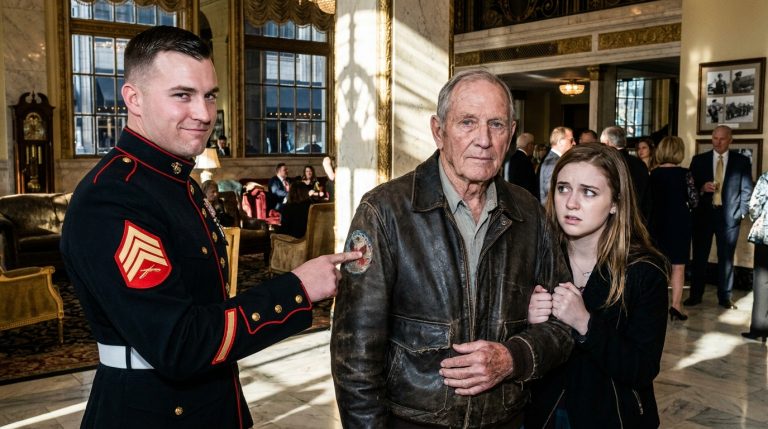
The fluorescent lights overhead hummed, a persistent, jagged vibration that seemed to match the thrum of blood in Miller’s ears. He had his hand hooked into the soft fabric of the man’s blue shirt, the material bunching beneath his knuckles, taut and worn.
“I said move it, old man,” Miller spat, his voice echoing off the sterile linoleum of the administrative wing. He wanted the Specialist at the end of the hall—the one who had just shattered a tray of coffee—to look at him. He wanted her to see a Marine in control, a man who didn’t tolerate disruptions in the sacred command element.
But she wasn’t looking at him. Her eyes were fixed on the man Miller was currently pinning to the wall.
Jeffrey Warner didn’t struggle. That was the most unsettling part. His breathing remained rhythmic, slow, the lungs of a man who had long ago learned how to conserve oxygen in the thin air of impossible places. The old man’s face was a landscape of deep-set lines, but his eyes—those faded, watery blue eyes—didn’t blink. They were locked onto Miller’s own with a disarming, heavy stillness.
It felt like staring into a deep well.
“You think you’re enforcing order,” Jeffrey said. His voice was gravelly, low, a sound that bypassed the ear and resonated directly in the chest. “But you’re only broadcasting your own fear.”
Miller’s pulse spiked. “I’m not afraid of anything, sir. Especially not of you.” He gave the man’s arm a sharp, aggressive twist.
Jeffrey’s knee hit the floor—a soft, wet thud against the cooling puddle of coffee—but he didn’t cry out. He only looked down at Miller’s hand, then back up. “You’re afraid that if you aren’t the loudest voice in the room, you’ll disappear. And that is why you’re so loud.”
The air in the hallway shifted. It became dense, pressurized, the scent of antiseptic suddenly drowned out by a phantom drift of ozone and damp earth. Miller felt a strange, cold prickle at the base of his neck. The specialist at the end of the hall was backing away now, her fingers trembling as they fumbled for the radio on her belt.
Miller leaned in, his face inches from Jeffrey’s. He had the advantage. He had the rank, the height, and the momentum. He was the future of the Corps, and this man was a ghost of a forgotten era. Yet, as he held the man’s arm, he noticed something he had missed: a tiny, unassuming pin on the collar of that frayed blue shirt—black enamel, gold rim, catching the light like a star in a dark sky.
It was a small thing, nearly invisible, but it held a gravity that made Miller’s own uniform suddenly feel like a costume.
“I asked for your ID,” Miller growled, though his conviction was fraying at the edges. “Last warning.”
Jeffrey didn’t reach for a pocket. He didn’t look for a wallet. He simply leaned forward, his weight balanced on his good knee, his gaze unyielding. “I don’t think you want to see who I am, son. Because once you see it, you won’t be able to look away from what you’ve done today.”
The stairwell door at the far end of the hall suddenly exploded inward.
CHAPTER 2: The Cascading Collapse
The sound was not merely a door opening; it was a structural failure of reality. The metal frame groaned under the impact, a sharp, dissonant clang that tore through the sterile hum of the hallway. For a second, the corridor was suspended in a vacuum of disbelief.
Miller’s hand, still clutching the fabric of the royal blue shirt, didn’t move. He felt the tremor in his own fingers, a sudden, unwanted betrayal by his body. His brain, conditioned to recognize the insignia of rank and the hierarchy of command, struggled to process the flood of olive and taupe pouring through the breach. Three stars. Two stars. Another two stars. Seven stars in total, filling the narrow space with a kinetic weight that pressed the air out of Miller’s lungs.
The hallway, previously a stage for his performance of authority, now felt like a cage.
General Vance led the surge. He was a man defined by granite-hewn features and a posture that commanded the very oxygen in the room. He didn’t look at Miller; he didn’t even acknowledge the three Marines who stood paralyzed in his wake. His eyes, burning with a frantic, protective intensity that Miller had never seen, were fixed solely on the man he had been shoving only seconds before.
As Vance dropped to his knees—an action so jarring it made Miller’s jaw ache—the coffee-stained floor seemed to expand, becoming the only focal point in the world. Vance didn’t care about the dark, spreading puddle soaking into his pristine service trousers. He didn’t care that the mess was a direct result of the chaos Miller had facilitated. He was only concerned with the old man’s arm.
Jeffrey Warner, the man Miller had dismissed as a nuisance, leaned slightly on his cane. His expression wasn’t one of anger or triumph. It was a strange, quiet patience, as if he were watching a storm dissipate after having lived through a thousand like it.
“Sir,” Vance said, his voice dropping into a register of raw, exposed vulnerability. “Are you injured? Did they hurt you?”
Miller felt the blood drain from his face, leaving his skin cold and tight. The word sir didn’t just feel out of place; it felt like a blasphemy. He looked to his left, expecting a flash of camaraderie or support from Ortiz or Davis, but they were shadows of men now, their shoulders hunched, their eyes locked onto their own polished boots. They were already retreating into the safety of absolute silence.
General Sterling and General Halloway were right behind, their faces mirrors of Vance’s own stricken expression. Sterling, a man whose reputation for detachment was legendary across the command, reached down to retrieve the cane Miller had kicked away. His movements were tender, almost reverent, as he wiped the wax and grit from the handle with his own sleeve.
Miller tried to swallow, but his throat was dry, coated in the metallic taste of panic. He remembered the tiny black and gold pin on the blue shirt. He saw it now, in the harsh, unflattering light of the corridor, and it seemed to pulse with a significance he had been too arrogant to decipher.
Vance stood up then, his motion slow, deliberate. He turned to face Miller, and the transformation was so complete it was terrifying. The concern for Jeffrey vanished, replaced by a cold, arctic fury that felt like a physical blow. The general didn’t move fast, yet the distance between them vanished in an instant. Vance stood close enough that Miller could see the fine webbing of veins in the older man’s eyes, the weariness of a decades-long career of command.
“Corporal,” Vance said. The word was stripped of any rank or military courtesy; it was used as a label of inadequacy.
“Sir,” Miller squeaked. His voice was a thin, brittle sound that did nothing to fill the cavernous silence of the hallway.
“Do you know who this man is?” Vance’s voice was barely a whisper, yet it resonated with more volume than any shout.
Miller’s vision blurred. He tried to search for a name, a citation, a memory from the manuals he had studied, but his mind was a white-out of fear. The world he had built—a world of rigid lines, defined power, and clear winners—had been irrevocably broken. He felt the fraying edges of his own narrative, the realization that he hadn’t been the hunter in this corridor, but a small, blind child standing in the path of a tectonic shift.
“No, sir,” Miller whispered, his knees threatening to betray him. He looked at the old man, who was now quietly watching the interaction with the detached, analytical gaze of a veteran observing a mistake in the field.
Vance didn’t answer immediately. He let the silence stretch, a long, agonizing bridge between Miller’s current failure and the weight of what was coming next. He pointed a trembling, rigid finger at the blue shirt, and for the first time, Miller saw the true scale of his error.
CHAPTER 3: The Unmasking of the Unseen
General Vance’s finger remained extended, a rigid pointer of accusation that felt, to Miller, like a live wire. The air in the hallway had grown thin, the kind of pressurized atmosphere that usually preceded a violent squall. Miller stared at the royal blue shirt, tracing the slight, deliberate shift of Jeffrey’s shoulders as the old man moved with a grace that mocked the Corporal’s own rigid, trembling stance.
“This man,” Vance continued, his voice a low, gravel-heavy vibration that seemed to make the very walls shudder, “is Command Sergeant Major Jeffrey Warner.”
The name didn’t land as a sound; it landed as a physical weight. Miller’s grip on reality fractured. He had spent his entire military life sharpening his instincts to spot the hierarchy, to identify who mattered and who was merely scenery. He had looked at this man and seen a ghost in ill-fitting slacks. He had seen an orthopedic casualty. He hadn’t seen the shadow of an architect.
“You don’t know the name,” Vance observed, and the utter lack of surprise in his voice was more stinging than an insult. It was a cold, objective assessment of failure. “That is a failure of your leadership and a failure of your education. But let me educate you right now.”
Vance stepped closer. The motion was so fluid, so predatory, that Miller’s own training—the reflexive urge to secure his space—flared. But his body wouldn’t obey. He was anchored to the spot, pinned by the collective gaze of the three generals who stood behind their former mentor like a phalanx of silent, watchful sentinels.
“This man,” Vance said, his voice rising, carrying down the hollow length of the corridor so that the Specialist—still trembling with her phone in hand—could hear every syllable, “held the perimeter at Firebase Delta for three days alone after his entire platoon was incapacitated.”
Miller’s vision tunneled. A sudden, sharp memory flickered at the edge of his perception—a line from a training manual, a photograph in the base museum he had skipped past because he was too busy checking his reflection in the glass. He felt the cold realization that he had been standing in the presence of a history he had been hired to protect, but which he had actively sought to suppress.
Jeffrey Warner didn’t intervene. He stood with his hands resting lightly on the head of his cane, his posture deceptively relaxed. The royal blue shirt, once a target of Miller’s mockery, now looked like a uniform of a different kind—a badge of someone who had survived everything this sterile, bureaucratic base could throw at him and had come out the other side with his humanity intact.
General Halloway moved forward, her face a mask of controlled, icy intensity. “He isn’t just a veteran, Corporal,” she said, her voice sharp enough to draw blood. “He is the veteran. He is the reason half the tactics you currently pride yourself on even exist. He is the reason we are standing here, alive, to reprimand you.”
The hallway floor, slicked with the dark, jagged stain of spilled coffee, seemed to tilt beneath Miller’s feet. He felt a sudden, visceral phantom sensation—the smell of sulfur and damp rot, the frantic, wet heat of an environment far from the climate-controlled sterility of the administrative wing. The sensory distortion hit him hard, a psychological echo of the violence that Jeffrey had lived and survived.
Miller took a half-step back, his boots slipping on the linoleum. The sound was loud, a screech of rubber on wax that echoed like a gunshot.
“I… I didn’t know,” Miller stammered, his words feeling like sand in his mouth.
Jeffrey finally shifted his weight, his eyes—that pale, watery, all-seeing blue—drifting toward Miller. “You thought I was weak because I am old,” Jeffrey said. His voice was soft, devoid of the jagged edge Vance carried, but it cut deeper. “You thought I was irrelevant because I was not in uniform. You judged the book by a cover that has been worn down by time, but you never bothered to check if there were pages inside.”
Jeffrey tapped the chest of Miller’s camouflage uniform with the end of his cane. The contact was light, a mere touch, but Miller felt the weight of it in his marrow. “This uniform,” Jeffrey said, “is not a license to be a bully. It is a weight. It is a promise. You serve the people—all of them. The confused, the broken, the ones who don’t fit into your neat, high-and-tight version of the world.”
The generals remained motionless, a wall of command element shielding the old man. Vance gestured to the two military police officers who had emerged from the shadows of the doorway. They were younger than Miller, their faces tight with the realization of the situation.
“Take these three into custody,” Vance ordered. The finality of the command was total. “Charge them with conduct unbecoming. Assault and disrespect to a superior commissioned officer.”
“Sir, he’s…” Miller started to plead, his voice cracking, but Vance merely turned his back on him, his full attention returning to the man in the blue shirt. The disregard was absolute. Miller watched as the MPs closed in, the reality of his shattered career settling over him like a shroud. He looked at the coffee on the floor, the mess he had prioritized over everything else, and saw the utter triviality of it.
He was being led away, his hands feeling hollow and empty, while behind him, the three generals hovered over Jeffrey Warner, their voices low and urgent. He caught a final glimpse of the old man—not as a victim, but as the only person in the entire wing who looked like he knew exactly what was happening, and exactly what it was going to cost to fix it.
CHAPTER 4: The Quiet Verdict
The detention room was an architectural void—four walls of brushed steel and concrete, lit by a single, flickering panel that hummed with a low-frequency drone. Miller sat on the edge of a bolted-down bench, his hands resting on his knees. They were trembling, a faint, rhythmic vibration he couldn’t suppress, no matter how hard he clamped his jaw.
He was waiting. He didn’t know for whom, or for what, but the uncertainty was worse than the shouting of the generals had been. In the hallway, there had been a structure to the rage; there had been a protocol to the destruction of his career. Here, there was only the oppressive, weightless silence of a man who had been rendered invisible.
The door didn’t slam open. It didn’t announce itself with the explosive authority of the generals. It simply clicked, the heavy magnetic lock releasing with a sigh of air, and then it swung wide.
Jeffrey Warner stepped inside.
He moved with the same slow, measured cadence that had seemed so out of place in the administrative corridor. Today, he wasn’t wearing the royal blue shirt. He wore a simple, charcoal-gray cardigan over a white button-down, a choice of clothing so mundane it was almost insulting. He didn’t look like a war hero. He looked like an old man visiting a library, or perhaps a grandfather checking in on a stray.
Miller stood up, his training reflexively urging him to snap to attention, but the habit died halfway. He had no rank left. He was just a body in a room, waiting for a sentence.
“General,” Miller said, the word feeling heavy and clumsy on his tongue.
Jeffrey stopped in the center of the room. He didn’t look at Miller immediately. He took a slow breath, his chest rising and falling with a rhythm that seemed to synchronize with the low drone of the light panel. He looked at the walls, then at the floor, observing the space with the same detached, critical eye he had used to assess the hallway.
“The room is too clean,” Jeffrey said softly. His voice lacked the gravelly bite it had possessed in the corridor; now, it was merely tired. “It doesn’t leave any space for a man to find himself. It just reflects everything back at him.”
Miller didn’t know how to respond. He stayed standing, his posture rigid, his eyes fixed on a point just above the old man’s shoulder. “I’m sorry,” he whispered.
Jeffrey finally turned to look at him. His eyes weren’t angry. They were worse—they were pitying. The blue was faded, washed out by decades of looking at things no one else was asked to carry. “You’re sorry that you were caught, Corporal. You’re sorry that the hierarchy you relied on turned against you. You aren’t sorry for the boy you hit, or for the man you tried to diminish.”
Miller flinched. The truth of the statement hit him like a physical blow. He tried to articulate a defense—something about the pressure of the command wing, the weight of the uniform, the expectation of efficiency—but the words died in his throat. In this room, against this man, they sounded like the frantic, hollow excuses of a child.
“General Vance wanted you out,” Jeffrey said, walking slowly to the bench and sitting down. The motion was stiff, the joints popping in the quiet room—a reminder of the physical cost of his own service. “He wanted you stripped, branded, and sent to a civilian prison where the silence would be absolute.”
Miller felt the air leave his lungs. He had expected the end. He had been preparing for the finality of it.
“I told him no,” Jeffrey continued, staring at the floor. “I told him that prison is too easy. It offers a man a bed, a schedule, and a way to wash his hands of his choices. You’d just be a victim of the system, just like you think you are now. You’d never have to look at the work you left undone.”
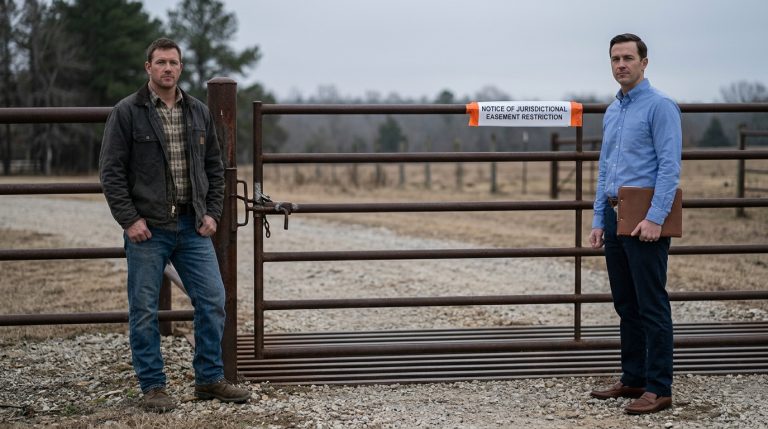
Jeffrey reached into his pocket and pulled out a small, worn photograph. He didn’t show it to Miller. He just held it, his thumb tracing the frayed edge. “I have a farm outside the perimeter. It’s not much. A few acres, a lot of fences that haven’t been painted in a decade, and a garden that’s mostly weeds. It’s quiet there. There are no ranks. There is only the soil, the wood, and the time it takes to maintain them.”
Miller looked at him, bewildered. “Why?”
Jeffrey turned his head, his gaze piercing. “Because you are young, and you are stupid, and you have power without an ounce of wisdom. The world has enough victims. It has enough bullies. What it lacks is people who understand the difference.”
He stood up, his movement slow but purposeful. “General Vance has agreed to my terms. You aren’t being discharged. You are being reassigned—not to a unit, but to me. For one month, you will live on that farm. You will do what I tell you, you will eat what I eat, and you will learn the weight of the things you think are small.”
Jeffrey stepped toward the door, then paused, looking back over his shoulder. “If you can last the month, if you can learn to see the difference between a command and an act of service, maybe you’ll be worth wearing that uniform again. If you can’t, you will leave. And you will be the only one to carry the memory of your own failure.”
He didn’t wait for an answer. He walked out, the door swinging shut behind him with a final, echoing click. Miller was left alone in the brushed-steel silence, his heart hammering against his ribs, staring at the space where the man had been, wondering if he had just been given a chance or a different kind of cage.
CHAPTER 5: The Friction of the Picket Fence
The sun was a physical weight, a white-hot hammer beating down on Miller’s neck as he stood before the sprawling, skeletal remains of the white picket fence. The wood was gray, weathered by years of neglect, and splintered under his touch. His uniform—stripped of all insignias, a plain, oversized t-shirt and work trousers—felt alien against his skin, lacking the structured comfort of the camouflage he had once worn like armor.
Jeffrey sat on the porch, thirty yards away, a glass of iced tea sweating in his hand. He wasn’t watching Miller with the hawk-eyed vigilance of a Drill Instructor. He was reading, turning pages with a slow, deliberate motion that ignored the Corporal entirely. That absence of attention was the most exhausting part of the day. There was no one to impress, no one to dominate, no one to prove his efficiency to. There was only the fence, the sandpaper, and the silence.
Miller dragged the sanding block across a stubborn patch of rot. The friction was violent, a harsh rasping sound that set his teeth on edge. Rrr-k. Rrr-k. The wood gave way in fine, pale dust, coating his forearms. Every movement reminded him of the morning he had spent in the hallway, the feeling of his own hand digging into the Sergeant Major’s shoulder. It seemed like a lifetime ago, yet the shame felt fresh, a static burn that wouldn’t dissipate.
He pushed harder, his muscles burning from hours of repetitive, meaningless labor. His ego, the carefully constructed edifice of his professional identity, was being sanded away just like the gray, dead layers of the pine.
“You’re rushing it,” a voice drifted from the porch.
Miller stopped, his breath ragged. He looked up, his brow slick with sweat. Jeffrey hadn’t looked up from his book. He hadn’t raised his voice.
“It’s just a fence, sir,” Miller called back, his voice thick with a mixture of fatigue and latent resentment.
“It’s not just a fence,” Jeffrey replied, turning a page. “It’s a boundary. If you don’t take the time to clean the rot, the paint won’t hold. If the paint doesn’t hold, the water gets in. And if the water gets in, the entire structure fails. It doesn’t matter how fast you work. It matters that you work correctly.”
Miller grit his teeth. He wanted to argue. He wanted to talk about mission parameters, about speed, about the importance of being the first to move. But there was no one to hear the argument. The farm was vast and indifferent, the wind sighing through the dry cornfields nearby with a sound that felt like a mockery of his professional urgency.
He bent back to the wood, his movements slower, more methodical. He felt a sudden, sharp ache in his knee—the same knee that had buckled in the sterile hall—and he realized he had been pacing himself based on the Sergeant Major’s own pace. He wasn’t trying to show off; he was trying to understand.
The heat began to shift, the sun dipping lower, casting long, bruised purple shadows across the yard. His hands were blistered, the skin raw where the handle of the brush had rubbed, and his shoulders ached with a deep, marrow-level exhaustion. He had spent his entire career running toward an objective, always looking for the next promotion, the next challenge, the next badge to pin to his chest. Now, the objective was simply to finish one section of white pine.
He stopped, standing up to stretch. He caught Jeffrey watching him now, over the top of his glasses. The old man didn’t smile, but his expression had shifted. The pity was gone, replaced by a cool, analytical observation.
“The first week is always the hardest,” Jeffrey said. He stood up, his joints popping, and walked down the porch steps. He walked over to the fence, his cane biting into the soft earth. He looked at the section Miller had sanded. “You left a spot near the knot. It’ll bleed through the paint.”
Miller looked at the wood. Sure enough, a dark, resinous circle sat hidden beneath the surface. “I missed it.”
“You were looking at the finish line, not the work,” Jeffrey corrected. He tapped the wood with his cane. “That is the lesson of the hallway, Corporal. You were so focused on the authority you thought you commanded that you failed to see the humanity right in front of you. You see the rot now?”
Miller looked at the knot, then at the old man. The anger that had fueled him for so long felt brittle, like the old, desiccated paint he had been peeling away for hours. “I see it,” he said, his voice quiet.
“Good,” Jeffrey said. “We’ll be here until the sun goes down. Tomorrow, we start the shed.”
Miller took the sandpaper back up. He didn’t feel like a Marine, and he didn’t feel like a prisoner. For the first time in his life, he felt like a man learning to be useful. He pressed the block against the wood, the rasping sound filling the air, and he didn’t look at the porch again. He looked at the rot, and he began to clean it out, one stroke at a time.
CHAPTER 6: The Resonance of Duty
The final brushstroke was not a flourish; it was a settling. Miller held his breath as the white paint smoothed over the last stubborn knot in the wood, covering the resin that had bled through the previous layer. He set the brush down on the rim of the metal bucket. The silence of the farm, once an irritant that had scraped against his nerves, now felt like a shroud of comfort. The air was cool, the scent of approaching rain mingling with the rich, dark smell of the garden soil.
Jeffrey Warner stood a few paces behind him. He hadn’t said a word for the better part of the hour, but Miller could feel his presence—a quiet, grounded weight that didn’t demand attention, but simply commanded it.
“It’s done,” Miller said. His voice was steady, stripped of the bravado and the frantic, defensive edge that had characterized his presence at the base.
“The fence is done,” Jeffrey agreed. He walked forward, his cane making soft, rhythmic impressions in the dirt. He reached out and touched the wood Miller had just painted. He felt the smoothness of the surface, checking for drips, for missed spots, for the casual shortcuts Miller had been obsessed with six months ago.
Jeffrey nodded once, a gesture so subtle Miller almost missed it. “It will hold the season.”
Miller wiped his hands on a rag, his fingers stiff, his skin calloused and stained with the remnants of his labor. He looked out over the fields. The sun was dipping below the horizon, painting the sky in colors that seemed too vast, too unhurried for someone who had spent his life operating on the frantic clock of military bureaucracy.
“I’m ready to go back,” Miller said. The words surprised him. He didn’t mean go back to the arrogance, to the sterile hallways, to the uniform that had felt like a shield. He meant go back to the life he had been given, now that he knew how to carry it properly.
Jeffrey looked at him, and for the first time, Miller saw the full reflection of the man’s history in those watery, blue eyes. It was a history of sacrifice—not for rank or ribbons, but for the fundamental, quiet act of being the line that held against the darkness.
“You aren’t the same man who arrived here, Corporal,” Jeffrey said, his voice soft. “But don’t mistake this for a total departure. The world you’re returning to hasn’t changed. The hallways will still be sterile, and there will still be people who think power is a substitute for purpose. The only thing that has changed is the weight you’re carrying.”
“I think I understand that now,” Miller replied. He looked down at his own hands—the same hands that had gripped the Sergeant Major’s arm in a moment of undisciplined rage, now steady, calloused, and useful.
Jeffrey reached into his pocket and pulled out the small, black-and-gold enamel pin he had worn on his collar that day in the hallway. He held it out. It was no larger than a dime, but in the dimming light, it caught the last flickers of the sun.
“I don’t give this to many people,” Jeffrey said. “It doesn’t signify rank. It doesn’t signify a medal. It signifies the responsibility to be the one who listens when others are only shouting.”
Miller took the pin. It was surprisingly heavy, a cold, solid weight against his palm. He looked up at Jeffrey, wanting to offer a formal salute, wanting to offer some grand, military-styled acknowledgment, but the gesture felt suddenly hollow. Instead, he simply bowed his head, a gesture of deep, unadorned respect.
“Thank you, sir,” Miller said.
“Don’t thank me,” Jeffrey said, turning back toward the house. “Just ensure that when you put that uniform back on, you remember the texture of this wood. Remember that the smallest actions are the ones that hold the structure together.”
Miller watched him walk away. The old man’s limp was visible, the physical toll of a life lived in the red zone, yet he moved with a purpose that made Miller’s own strength feel amateurish. Miller looked down at the fence one last time. It was a simple, white, picket fence—a mundane, unremarkable structure—but it was solid. It was straight. It was earned.
As he turned to head toward the main road, the silhouette of the base loomed in the distance, a sprawling, illuminated fortress against the deepening twilight. He knew what awaited him: the reprimands, the administrative hearings, the long process of earning his way back into the good graces of a system that didn’t know how to handle the version of him that had returned from this farm.
He didn’t care. The fear that had once ruled him, the terror of being irrelevant, had been replaced by the quiet, immutable knowledge of who he was. He tucked the pin into his pocket, his hand brushing against the sturdy, fabric of his trousers. He began to walk. The road was long, the journey back would be difficult, but for the first time in his life, he wasn’t running toward a title. He was walking toward his duty.